Hermes Agent Pricing: Self-Hosted Cost vs Managed Hosting
What Hermes Agent really costs when you self-host it versus using managed hosting, including infrastructure, time, and operational overhead.
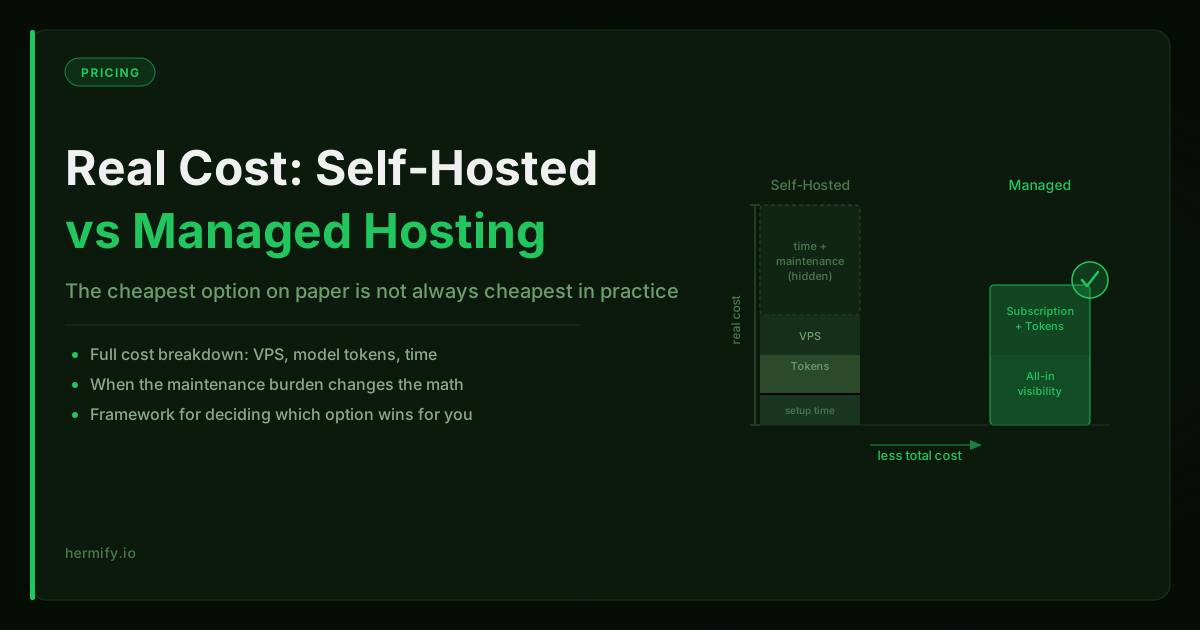
The Cheapest Option on Paper Is Not Always the Cheapest in Practice
Self-hosting Hermes Agent looks cheap at first glance. Rent a VPS for $6/month, add your model API costs, and you are done. The invoice is low.
That framing omits most of the actual cost.
The real cost of a self-hosted Hermes deployment includes the server, the model tokens, and the ongoing human time required to keep it running. That last component, time, does not show up on any invoice, but it accumulates steadily.
This guide breaks down both options with the hidden costs included.
The Full Cost of Self-Hosting Hermes
Infrastructure: $4–$15/month
A minimal Hermes deployment runs on a $6/month VPS from Hetzner or DigitalOcean. You need Ubuntu or another supported Linux distribution, SSH access, and enough RAM to run the Hermes process comfortably (1GB minimum, 2GB recommended for reliability under load).
Model API usage: $5–$30/month
This depends entirely on how much you use the agent and which model you run. Claude 3.5 Sonnet on OpenRouter costs roughly $3 per million input tokens and $15 per million output tokens. Regular daily use (10–20 conversations with full memory context) might run $10–$25/month. Heavy use can push higher.
Initial setup time: 2–8 hours
The official quickstart is fast. Getting to a reliable production deployment, proper process management, data persistence, Telegram gateway configured and running, credentials stored securely, takes substantially longer, especially if you are not already familiar with Linux server administration. If you hit problems with Telegram configuration (which most users do), add another 1–2 hours.
Ongoing maintenance: 30–90 minutes/month
This is where the self-hosted cost keeps accumulating. Every month, you will spend some time on:
- Monitoring: checking that the bot is still responding
- Updates: deciding when to update Hermes and handling any breaking changes
- Debugging: the occasional crash, gateway disconnection, or out-of-memory event
- Restarts: after server maintenance, OS updates, or process failures
Thirty minutes a month sounds trivial. Spread over a year, it is 6+ hours, and that assumes nothing goes seriously wrong.
Total self-hosted cost example (first year):
| Component | Monthly | Annual |
|---|---|---|
| VPS (1GB) | $6 | $72 |
| Model API | $15 | $180 |
| Initial setup (8 hrs × $X) | one-time | one-time |
| Ongoing maintenance (1 hr/mo × $X) | variable | variable |
The dollar-per-hour value you assign to your time determines whether self-hosting is actually cheaper.
The Full Cost of Managed Hosting (Hermify)
Platform subscription: varies by plan
Hermify plans cover the hosting, process management, data persistence, and uptime monitoring. The subscription replaces the VPS cost and the operational time.
Model API usage: same as self-hosted (with BYOK), or bundled
On Hermify's Starter plan, you bring your own OpenRouter or Anthropic API key and pay those costs directly. On higher plans, model access is bundled into the subscription. Either way, your model cost is the same as or lower than self-hosted because you have one fewer management overhead.
Initial setup time: 15–30 minutes
The onboarding flow guides you through provider configuration, Telegram setup, and first deployment. There is no server to provision, no process manager to configure, and no SSH session required.
Ongoing maintenance: near zero
The platform handles process health. If the runtime crashes, it restarts automatically. If you need to update credentials or change the model, you do it through the dashboard. There is no monitoring to set up because the status card in the dashboard shows whether your agent is running.
Where the Math Changes
The crossover point depends on what your time is worth.
If your hourly rate (or opportunity cost) is $50, then:
- Self-hosting setup cost: 8 hours × $50 = $400 one-time
- Self-hosting maintenance: 12 hours/year × $50 = $600/year
- VPS + model: ~$250/year
Self-hosted true annual cost (year 1): ~$1,250 (including setup time) Self-hosted true annual cost (year 2+): ~$850/year
If Hermify's subscription is $25/month with BYOK:
- Managed setup cost: 30 minutes × $50 = $25 one-time
- Managed maintenance: ~0 hours
- Subscription + model: ~$480/year
Managed true annual cost (year 1): ~$505 Managed true annual cost (year 2+): ~$480/year
At $50/hour, managed hosting is cheaper from day one. At $10/hour, self-hosting becomes cheaper in year two. The crossover is entirely determined by what your time costs.
What the Pricing Question Is Really About
Most people asking about Hermes Agent pricing are not trying to optimize a spreadsheet. They are trying to answer a simpler question: "is this worth paying for, or should I figure it out myself?"
The honest answer:
Self-hosting is worth it if you enjoy managing infrastructure, you already have a server, and the operational work is not friction for you. The direct costs are real but lower.
Managed hosting is worth it if you want the agent to work reliably without the ongoing operational responsibility. The subscription cost is offset by the time you do not spend maintaining it.
The worst outcome is paying the subscription and spending time debugging, or self-hosting and then having the agent go offline for a week because you forgot to renew the VPS. Both paths require choosing them fully.
The Hermify Approach to Pricing
Hermify is designed around the thesis that a persistent, self-improving agent accumulates real value over time, and that value is undermined if the deployment is unreliable. The subscription pays for reliability, not just compute.
This means:
- Persistent data volumes on every plan, so your agent's memory survives container restarts
- Automatic process management, so the Telegram bot stays online
- Dashboard-accessible controls, so maintenance takes seconds instead of an SSH session
If you want to see what the plans actually include and how the pricing compares to a DIY VPS setup, the Hermify hosting page has the current details. If you are ready to deploy, the deploy Hermes Agent page walks through the full onboarding flow.
Run Your Own Hermes Agent
Bring your API key, connect Telegram, and get a self-improving AI agent live in 60 seconds.
Get Started