AI Agent for IT Support: Solo Sysadmins and Small MSPs
AI agents can triage tickets, diagnose outages, and answer clients around the clock. Here is what fits enterprise IT versus a solo sysadmin or small MSP.
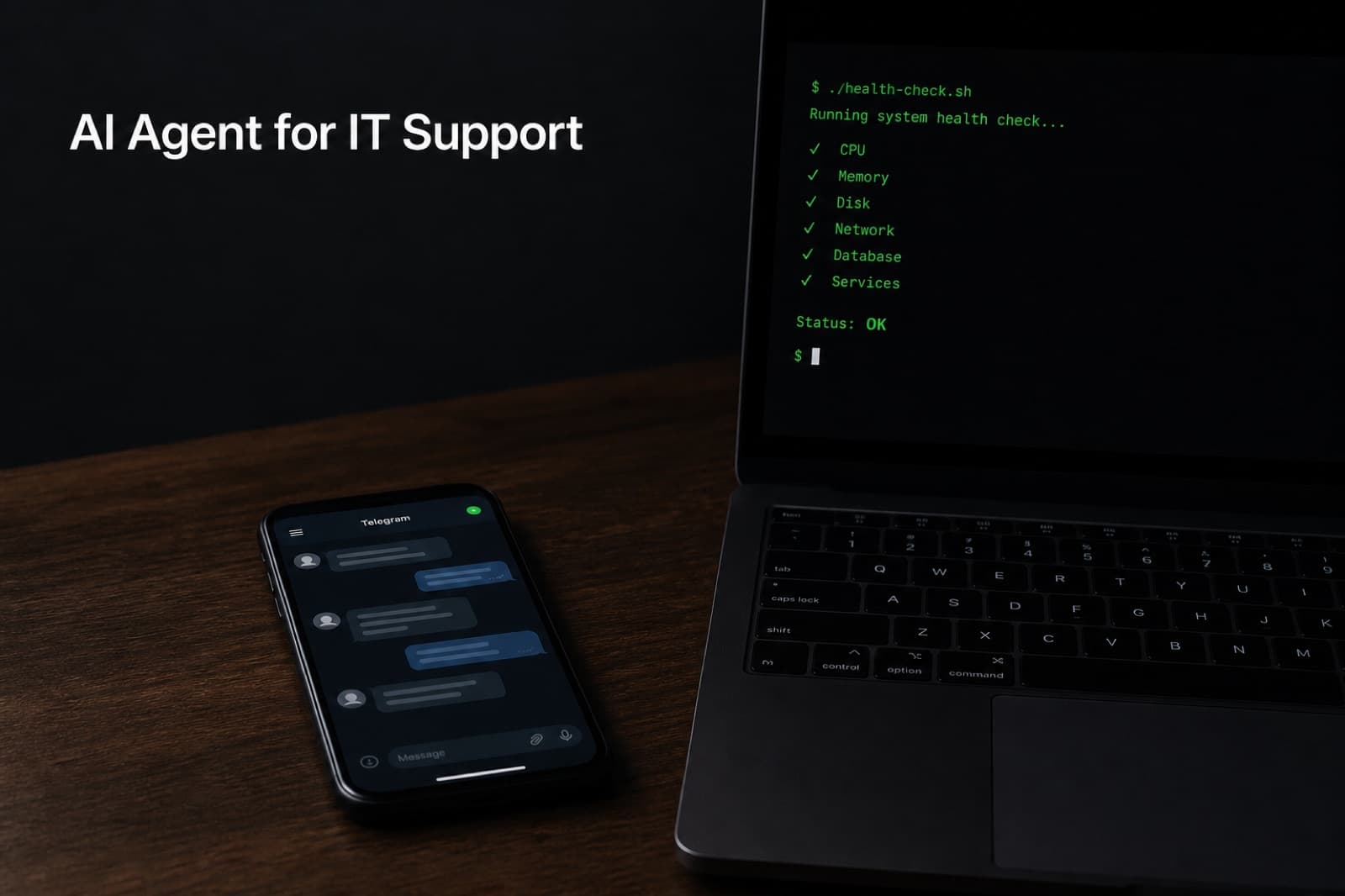
You run IT for a handful of clients. A cert expires on a Sunday, a small business's mail server goes down mid-afternoon, and the same three questions arrive by email every week. You are the on-call rotation, the ticket triage, and the person who has to remember which Windows box has the odd VPN configuration from 2023. An "AI agent for IT support" is starting to sound less like hype and more like a co-worker you can afford.
The category is real, but most of the tooling being marketed at it right now is built for a very different customer. This post walks through what an AI agent can actually do in IT work in 2026, what the enterprise stack looks like, where it stops fitting a lean operator, and a lighter self-hosted pattern that works for a solo sysadmin, freelance IT consultant, or a two-to-five person MSP.
What an AI agent actually does in IT support
The label "AI agent" has been stretched thin, so it helps to name the concrete jobs. In IT work, an agent (as opposed to a plain chatbot) usually does some subset of these:
- Ticket triage. Reads the incoming message, categorizes it, sets priority, drafts a first response, and routes it to the right queue.
- Incident investigation. When a monitor fires, it pulls the last hour of logs, cross-references recent deploys, forms a hypothesis, and posts a diagnosis.
- Runbook execution. Restarts a service, rotates a key, expands a disk, or reruns a failed job - the safe, documented actions you already have runbooks for.
- Client-facing Q&A. Answers the tenth "how do I reset my password" of the week without waking you.
- Health checks and reporting. Pings client infrastructure on a schedule, remembers which host does what, and sends a weekly summary.
- Voice and note capture. Takes your on-site voice memo ("that client's UPS battery is dead, order a replacement"), turns it into a ticket, and remembers it next month.
Not every product does all six. That is the first filter when you go shopping.
The enterprise stack in 2026
The big names are aimed squarely at large SRE teams and full-service MSPs with dozens of technicians. They are powerful, and the numbers are impressive, but the price and the integration surface are enterprise-sized.
AWS DevOps Agent went generally available on March 31, 2026, built on Bedrock AgentCore. It listens on CloudWatch, PagerDuty, Dynatrace, and ServiceNow, and starts investigating incidents autonomously. AWS reports up to 75% lower mean time to resolution, 80% faster investigations, and 94% root cause accuracy across preview customers. Western Governors University's SRE team cut a real production incident from an estimated two hours to twenty-eight minutes, a 77% MTTR improvement. Pricing is $0.498 per agent-minute, billed while it runs investigations.
Atera's Robin targets the MSP helpdesk. Atera reports Robin reaching a 92% autonomous resolution rate at an average of two minutes per ticket, versus 188 minutes for human-only handling, freeing roughly 40% of a technician's workload and giving back eleven to thirteen hours per week per technician.
LogicMonitor's Edwin AI focuses on alert noise. In a published APAC case study, one MSP cut alert noise by 78% and reduced incident volume dramatically after wiring Edwin into their operations pipeline.
ConnectWise Sidekick is the AI layer inside ConnectWise's PSA and RMM stack, offering more than seventy AI-assisted actions across the technician workflow.
Thread is a conversational front-end that gathers information from users through chat, email, Teams, or Slack before a technician sees the request - so the ticket arrives already categorized, with context captured.

Why the enterprise stack does not fit a solo operator
Read the pricing pages carefully and a pattern shows up. These platforms assume:
- A ticketing system (ConnectWise, ServiceNow, Autotask) with per-seat licensing.
- Deep integration with one hyperscaler's observability stack.
- A dispatcher role that is already saturated and worth augmenting at $0.50 a minute.
- A technician count where 40% workload savings shows up as headcount you can redeploy.
If you are a one-person shop or a two-to-five person MSP running mostly on VPSes, small Kubernetes clusters, some on-premise Windows Server boxes, and a scattering of client SaaS accounts, most of that scaffolding is not there. You do not have a dispatcher. Your ticket volume is measured in dozens per week. And your budget for AI tooling is closer to $30 a month than $3,000.
That does not mean the value is fake, only that the shape of the tool has to change.
What the solo sysadmin or small MSP actually needs
Strip the enterprise stack down to what a lean operator will actually use every day, and you are left with a much shorter list:
- A channel you already live in. Not another dashboard. Telegram, Signal, Slack, or email - somewhere your phone already pings.
- Memory of who each client is. Which server has the weird cert renewal script. Which client refuses to update Java. Which project is behind on invoicing. Memory that persists across sessions, not a chat window that forgets after a day.
- A small, well-defined action set. Read a log file over SSH. Query a monitoring endpoint. Send an email draft for your approval. Post an update to a Trello card. Ten well-picked tools beat a thousand pluggable connectors you never wire up.
- Scheduled work. A cron that runs a health check on Monday at 07:00 and posts one message per client - "everything is green, cert on client-A expires in 34 days" - without any prompting.
- A cost model you can predict. Per-month, not per-agent-minute. Ideally bring-your-own-key so a bad prompt in a loop cannot bill you into next month.
Almost none of the enterprise offerings hit all five for a solo operator. But an open-source, self-hosted agent on Telegram does.
A lighter pattern: a self-hosted agent on Telegram
The pattern most independent sysadmins are landing on in 2026 is a small AI agent (like the open-source Hermes Agent, Nous Research's self-improving agent) running on a $5-$7 VPS, wired to Telegram as its primary interface, with model calls billed per-token on your own API key (typically $2-$15 a month for a solo operator's usage). The whole thing fits on a 1 vCPU, 2 GB RAM box.
From the operator's chair it looks like a Telegram contact called "SysBot" who:
- Reads incoming client emails you forward it, drafts a first response in your voice, and asks you to approve.
- Runs scheduled
pingand TLS-expiry checks against every client host you register, and only pings you when something is amber or red. - Remembers each client in a plain-text file you own (
clients/acme.md,clients/beta-corp.md), which you can edit by hand, back up, and version in git. - Takes voice notes from an on-site visit - "acme's rack has a dead PSU in slot 2, order tomorrow" - and files them as tasks against the right client.
- Answers your late-night "which client was that DNS thing last spring" with a summary because it still has the memory.
This is not fantasy. It is the exact use case the busy-technician self-hosted AI agent and silent uptime monitoring patterns already cover. What is new is that the tooling to wire it together has gotten simple enough for a solo operator to stand up in an afternoon.
A concrete week-one setup
If you want to try this, here is a starter shape that solo IT consultants have been using:
- Provision a VPS. Any $5-$7 box - Hetzner, DigitalOcean, Vultr - with 1 vCPU and 2 GB of RAM is enough. Harden SSH, enable unattended upgrades, and set up basic firewalling.
- Install an open-source agent. Hermes Agent runs as a Docker container. Point it at a Telegram bot token and add yourself to the allowed-users list. First message in about ten minutes.
- Give it your client memory folder. Create
~/hermes-memory/clients/with one Markdown file per client covering hosts, contacts, quirks, renewal dates. The agent reads and writes these across sessions. - Wire two tools first. Skip the temptation to add twenty. Start with (a) an SSH-over-Tailscale tool for read-only diagnostic commands and (b) an SMTP tool that drafts email replies for your approval. Add more only when you know you need them.
- Schedule the boring stuff. Add a daily cron that runs a health sweep across the client hosts and posts a single message. Add a Monday-morning cron that reads the last week's Telegram thread and produces a summary you can bill against.
- Keep escalation manual. For anything money-touching (rotating a production key, restarting a paid client's database, refunding an invoice), the agent proposes, you press the button. This is not enterprise SRE automation, and it should not try to be.
Get started with Hermify if you want to skip the VPS-hardening step. Hermify hosts a managed Hermes Agent on Telegram in about a minute, keeps the memory files as yours to export, and stays out of your way. If you would rather self-host, the self-hosted AI agent guide walks through the Docker path.
What this pattern does not replace
Be honest about the gaps, because they matter:
- No automatic rollback. AWS DevOps Agent can revert a bad deploy autonomously. A Telegram agent should not. You approve every write.
- No SaaS-grade SLO dashboards. If a client contract requires 99.95% with a status page, buy Datadog or Grafana Cloud.
- No PSA integration out of the box. If your business runs on Autotask or ConnectWise Manage, you will still write scripts to bridge the ticket system, or you will pay for Sidekick.
- Not for regulated industries in most cases. Healthcare, finance, and government IT support has compliance layers that a $5 self-hosted agent cannot replace on its own.
The point is not that this pattern replaces the enterprise stack. The point is that for the seventy percent of IT support work that is repetitive, memory-limited, and drowning in context-switching, an AI agent scaled to one person is a real productivity win at a real one-person price.
How to choose
- Managing a large SRE team, cloud-native workload, 24/7 SLOs? Look at AWS DevOps Agent, Atera Robin, or Edwin AI. The economics work at that scale.
- Running a small MSP with a PSA already installed? ConnectWise Sidekick or a Thread-style triage front-end is the shortest path.
- Solo consultant, freelance sysadmin, or lean two-to-five person MSP? A self-hosted or managed Hermes Agent on Telegram covers the daily work at a price that matches your revenue.
The right AI agent for IT support is the one that fits your ticket volume, your budget, and the tools you already have open. For a lot of us, that is not the one with the biggest booth at re:Invent.
Sources
- AWS DevOps Agent - AWS Blog (2026)
- AWS Announces General Availability of DevOps Agent - InfoQ (April 2026)
- Best AI Tools for IT Support Ticket Triage - Atera (2026)
- How One MSP Used AI to Cut Noise by 78% - LogicMonitor
- AI-Powered Automated Ticket Triage - Thread
- Hermes Agent - GitHub (Nous Research)
Run Your Own Hermes Agent
Bring your API key, connect Telegram, and get a self-improving AI agent live in 60 seconds.
Get Started