AI Assistant vs Virtual Assistant: Which Do You Need?
Comparing AI assistants vs virtual assistants on cost, availability, memory, and fit. An honest guide to help you decide which is right for you.
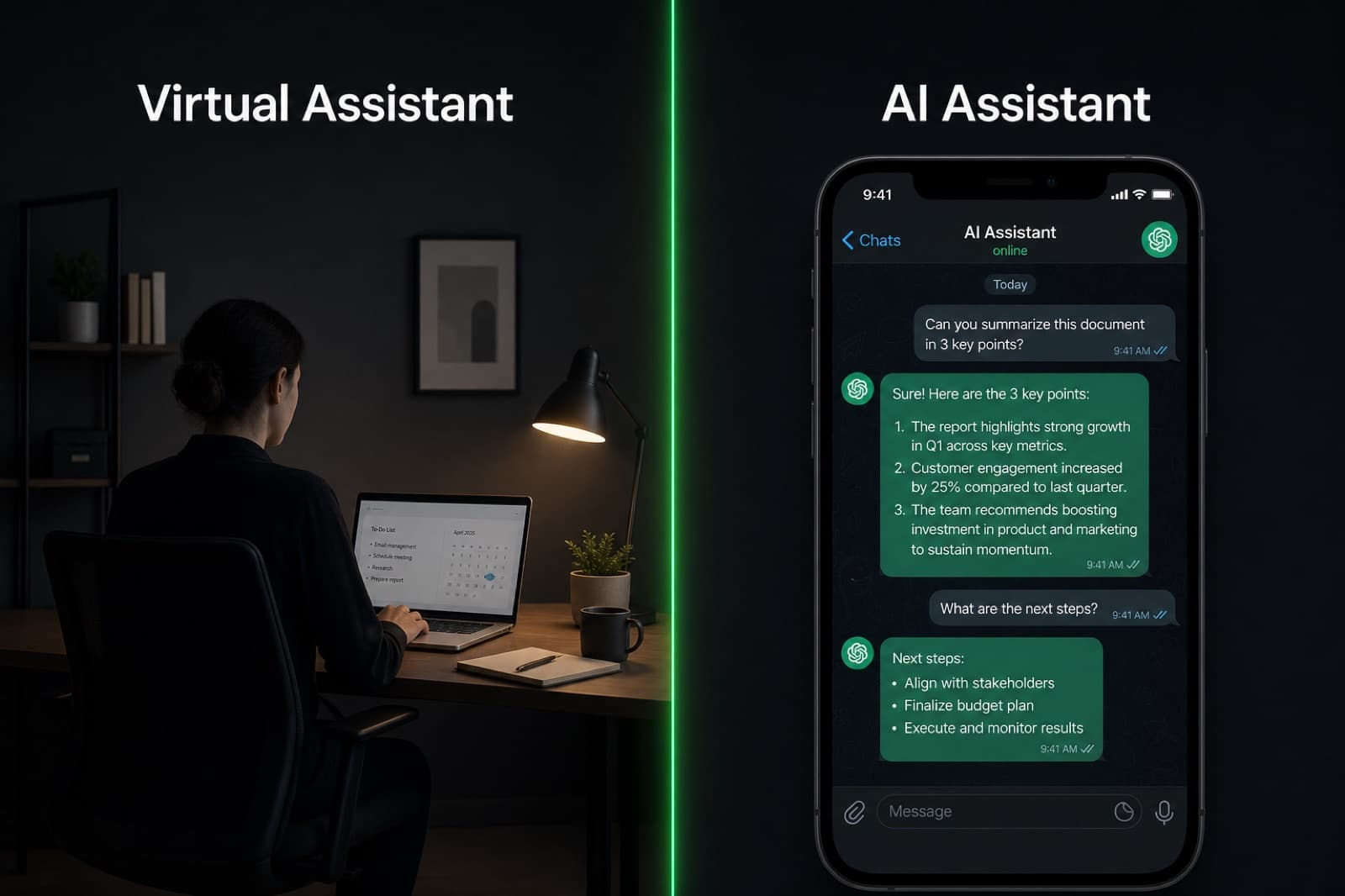
You need help running your day. Someone - or something - to handle the inbox, schedule meetings, track follow-ups, and surface the right information before you need it. The obvious question: do you hire a human virtual assistant, or do you use an AI assistant?
Both can take tasks off your plate. Both have real limits. The right answer depends on what those tasks actually are, how much you want to spend, and how much friction you can tolerate getting started. This post gives you an honest comparison so you can make the call.
What Each One Actually Is
Human Virtual Assistant
A human VA is a remote contractor who handles delegated tasks. They can draft emails in your voice, manage a complex calendar across time zones, do research, handle client calls, and make judgment calls you did not anticipate. They work set hours, charge by the hour or month, and need onboarding before they can work independently.
US-based VAs typically charge $25 to $55 per hour, which translates to roughly $3,000 to $8,000 per month for part-time to full-time support. Offshore VAs, often based in the Philippines or Latin America, run $5 to $17 per hour, bringing monthly costs down to $640 to $2,400 for similar hours. Agencies charge a premium on top of those rates for vetting and backup coverage.
AI Assistant
An AI assistant is software that understands natural language, follows instructions, and acts on your behalf. Modern AI assistants can manage calendars, draft communications, summarize documents, set reminders, search the web, and trigger integrations with other apps. Costs range from $20 to a few hundred dollars per month depending on the platform. They are available 24 hours a day, respond in seconds, and require no onboarding period.
The Hermes Agent from Hermify is one example: a personal AI assistant that runs on Telegram, keeps persistent memory of your preferences and ongoing projects, understands voice messages, and can be extended with custom skills. You go from sign-up to working agent in about a minute, with no servers to manage.

Head-to-Head: Six Dimensions That Matter
Cost
The cost gap is large. A part-time human VA at even the lower offshore rates costs at least $600 to $1,000 per month for 20 hours of work. A full-time US-based VA is $4,000 to $9,000 per month. AI assistant platforms start under $30 per month and rarely exceed $200 for a single professional user.
If cost is the deciding factor and your tasks are mostly routine - inbox triage, scheduling, reminders, document drafting - AI wins by a wide margin.
Availability
Human VAs work defined hours, usually in one time zone. If you need something at 11 PM or 6 AM, you wait. AI assistants never sleep. They handle a request the moment you send it, whether that is a Sunday afternoon or the middle of a flight with spotty wifi.
For professionals who work across time zones or have irregular schedules, the 24/7 availability of an AI assistant is not a convenience feature. It is a structural advantage.
Ramp-Up and Onboarding
A human VA typically needs two to four weeks of onboarding before they can work reliably without supervision. You explain your systems, your tone, your preferences, your recurring tasks. Some of that learning sticks; some needs to be re-explained after a break or when the VA is replaced.
A well-designed AI assistant with persistent memory works the other way around. You tell it your preferences once and it stores them. The Hermes Agent remembers that you prefer bullet-point summaries, that your CRM is HubSpot, and that you never accept Monday morning meetings - and that context carries forward into every future session.
Memory and Consistency
This is where the comparison gets interesting. Human VAs have excellent contextual understanding but inconsistent memory. They remember the big things, forget the small ones, and their style shifts when they are tired or distracted.
AI assistants with a proper memory layer are perfectly consistent. They apply the same rules every time and surface the same context without being reminded. The trade-off is that they do not have the implicit understanding a person brings after months of working together. They know what you told them; they do not know what you meant but never said.
What a Human VA Does Better
Some tasks genuinely require human judgment and should stay with a person, at least for now.
Relationship-intensive work is the clearest example. Building rapport on a client call, reading the room in a negotiation, deciding how much empathy to put in a difficult email - these require social intelligence that no AI assistant reliably provides today.
Complex research with ambiguous scope is another. A good VA asks the right clarifying questions and adapts mid-task when the research goes in an unexpected direction. AI assistants do this better than they did two years ago, but a senior human VA is still more capable when the task is genuinely open-ended.
Finally, tasks that involve physical coordination - visiting a vendor, picking up materials, attending an in-person event on your behalf - are beyond any AI assistant.
What an AI Assistant Does Better
Volume and repetition. AI assistants do not get bored, make typos from fatigue, or cost more when you send fifty requests instead of five. They are better at being consistent over hundreds of identical tasks than any person is.
Speed. AI assistants respond in seconds, not hours. For time-sensitive tasks like summarizing an email before a meeting that starts in three minutes, that speed matters.
Privacy at scale. Everything you tell an AI assistant stays in the system you chose. You do not need to worry about an employee discussing your business with their friends. That said, you should review the privacy policy of any AI platform carefully - data handling varies significantly between providers.
When to Use Which
Use a human VA if:
- Your tasks require genuine social judgment or relationship management.
- You need someone to represent you or your business in conversations with clients or partners.
- Your work is highly unstructured and changes week to week in ways that are hard to specify in advance.
- You are managing complex projects across multiple stakeholders where political context matters.
Use an AI assistant if:
- Your tasks are mostly routine: scheduling, inbox triage, reminders, drafting, summarizing.
- You need support outside of business hours or across time zones.
- Your budget is limited and you want to maximize the hours of support you get per dollar.
- You want a consistent, always-available layer of help that builds knowledge about your preferences over time.
Consider both if:
- You already have a human VA and want to multiply their output by giving them AI tools.
- You start with AI, hit tasks it genuinely cannot handle, and add a human VA for those specific areas.
The 2026 reality is that most small-business owners and busy professionals underuse AI and overpay for human help on tasks that do not actually require human judgment. The honest starting point is to list your twenty most common tasks, mark which ones genuinely require human discretion, and match accordingly.
The Replace AI assistant or Virtual Assistant Question
The "replace virtual assistant with AI" framing is a bit misleading. Most people are not replacing a human VA they already have. They are deciding what to start with. And for someone who has never had either, starting with an AI assistant is almost always the right call: lower cost, faster to deploy, and sufficient for the majority of routine tasks.
If you outgrow it, you add a human VA for the gaps. That is a much better problem to have than paying for a full human VA before you know whether you need one.
Start with Hermify - you can have a personal AI assistant running on Telegram with persistent memory in under a minute, and see for yourself which tasks it handles and which ones it does not.
Sources
- Virtual Assistant Cost in 2026: $4-$79/hour (Full Breakdown) - Wishup
- AI Virtual Assistant vs Traditional VA: Cost and Quality Comparison - AI Scale Labs
- AI Agent vs Virtual Assistant: Cost, Capabilities, and Which to Hire in 2026 - ClawAgora
- Virtual Assistant Industry Statistics 2026: Market Data and Trends - VA Masters
Run Your Own Hermes Agent
Bring your API key, connect Telegram, and get a self-improving AI agent live in 60 seconds.
Get Started