AI Assistant with Persistent Memory: 2026 Guide
The realistic options for an AI assistant that actually remembers you across sessions: ChatGPT memory, Mem0, Supermemory, Charlie Mnemonic, Hermes Agent.
You explain the same project to ChatGPT for the fourth time this week. You finally find a workflow that works, ask it to "remember this for next time," and three days later it has no idea what you mean. The conversation that felt brilliant on Monday is gone by Wednesday.
This is the persistent memory problem, and in 2026 it is finally tractable. The category that did not exist two years ago - "AI assistant with long-term memory" - now has real benchmarks, real products, and real architectural choices to make. This guide explains what those choices are, what each option actually gives you, and how to pick one that fits your workflow.
Why Built-in Memory in ChatGPT and Claude Is Not Enough
OpenAI shipped a memory feature in ChatGPT in 2024. Anthropic added profile summaries to Claude. Both help. Neither solves the problem.
The limits are structural, not bugs:
- Capacity: ChatGPT's memory stores roughly 1,200 to 1,400 words total, as compressed summaries. It is "a list of facts, not contextual understanding."
- Inconsistency: Memory retrieval is opaque. Sometimes the model uses what it has stored, sometimes it ignores it, and you cannot inspect or pin the logic.
- Scope: Memory only exists inside the chat web interface. The API has no memory unless you build it yourself with a database and token-passing.
- Lock-in: Your memory lives on the provider's servers, tied to your account on their product. Switch models, lose memory.
For a casual user this is fine. For anyone doing sustained project work, the OpenAI Help Center is explicit: memory "should not be relied on to store exact templates or large blocks of verbatim text." Read that as the spec, not a footnote.
Developers report spending "approximately 15 to 25 percent of interaction time with the agent re-establishing context." That is the real cost of weak memory, paid every session.

The Three Architectures for Persistent Memory
Once you accept that you need more than the chat product gives you, the field splits into three real architectures. Knowing which one a product uses tells you what it will be good and bad at.
1. Memory as a Layer You Add (Mem0, Supermemory, Zep)
These products are not assistants. They are memory APIs you plug into your own assistant or agent. You call them on every turn to retrieve relevant context, then write new facts back.
- Mem0 offers a three-tier scope (user, session, agent) backed by a hybrid of vectors, graph relationships, and key-value lookups. It scored 94.4% on LongMemEval-S with ~6,900 tokens per query.
- Supermemory is lighter and faster, treating memory as time-annotated semantic traces. It scored 85.4% on LongMemEval-S with sub-300ms recall.
- Zep uses a temporal knowledge graph and leads the temporal-reasoning subset of LongMemEval by 15 points over Mem0.
Pick this category if you are a developer building your own agent and you want best-in-class memory as a service. The downside is that you still have to build the agent.
2. Personal Assistant with Memory Built In (Charlie Mnemonic)
Charlie Mnemonic from GoodAI was the first open-source personal assistant with long-term memory as the headline feature. It is a research project, useful for studying continual learning, less polished as a daily-driver product.
Pick this category if you want a working memory-first assistant and you are comfortable maintaining a research codebase.
3. Self-Improving Agent with Memory as One of Five Pillars (Hermes Agent)
Hermes Agent, from Nous Research, takes a broader view. Memory is one of five core pillars - alongside skills, soul, crons, and self-improvement. The agent stores facts in MEMORY.md, per-user details in USER.md, and writes a new skill document every time it figures out how to do something complex, so it can reuse the procedure next time.
The "self-improving" framing has a precise meaning here. The model weights do not change. What changes is the agent's structured note-taking: better memory, better skills, better routines, all written as plain markdown the user can inspect and edit. Over months of use, the agent's behavior on your workflows genuinely improves.
Pick this category if you want a working assistant where memory is integrated with skills, scheduling, and the agent's overall sense of how to work with you - not just a retrieval API or a research prototype.
The Honest Comparison
| Option | What you get | What you give up |
|---|---|---|
| ChatGPT memory | Zero setup, works inside the chat product | ~1,400-word cap, opaque retrieval, no API, vendor lock-in |
| Mem0 / Supermemory / Zep | Best-in-class memory APIs, real benchmarks | You still build the agent |
| Charlie Mnemonic | Working memory-first assistant, open source | Research project, rougher edges |
| Hermes Agent | Memory + skills + crons + a real agent loop | You run it (or pay someone to run it) |
There is no free lunch. The chat-product memory is free because it is shallow. The API solutions are powerful because you do the integration work. The full agents work end to end because you host them.
What "Persistent" Actually Requires
Whichever architecture you pick, the same four requirements show up:
- Storage that survives restarts. Memory in process RAM is not memory; it is a context window with extra steps. Real memory writes to disk (markdown files, SQLite, a vector store) and survives the agent crashing.
- Retrieval that is deterministic enough to debug. When the assistant fails to recall something it should know, you need to be able to open the memory and see whether it was never written, written but not retrieved, or retrieved but ignored.
- A way to edit memory directly. The agent will, eventually, store something wrong - a stale preference, a wrong fact, an obsolete project state. You need to fix it without rebuilding the whole memory layer.
- An identity that follows you across devices and channels. The same agent that answered your Telegram message at 9am should be available in your terminal at 2pm with full context. Memory tied to a single channel is half a solution.
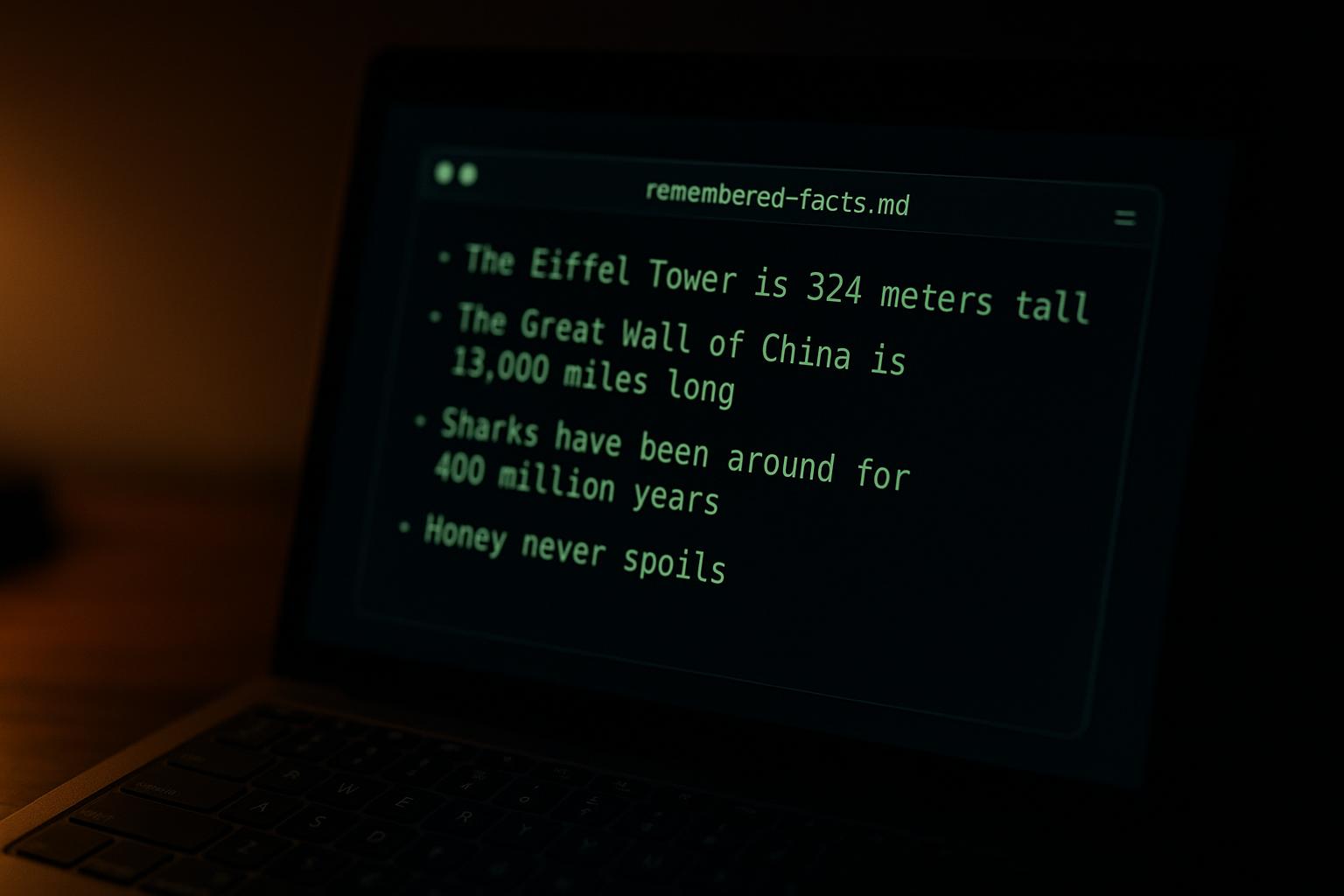
The markdown-file approach (Hermes Agent, MemPalace) wins points 2 and 3 cheaply: you cat MEMORY.md and you see exactly what the agent knows. The vector-store approach (Mem0, Supermemory) wins on scale and search quality but requires more tooling to introspect.
How to Choose
A short decision tree:
- You want zero setup, casual use, and accept the limits. Stay with ChatGPT memory. Do not pretend it is more than it is. For deeper context, see the ChatGPT alternative guide.
- You are a developer building your own product. Pick Mem0, Supermemory, or Zep based on benchmark fit (Mem0 for general use, Supermemory for speed, Zep for temporal reasoning).
- You want a working personal assistant that remembers everything, runs on your own hardware, and gets better as you use it. Run Hermes Agent. Read how Hermes memory and skills work to understand the mechanics before you commit.
- You want all of the above without running a server. Use Hermify, the managed hosting for Hermes Agent. Same memory model, same skills, no VPS to babysit. Get started with Hermify and you have a persistent-memory assistant on Telegram in under five minutes.
The Trade-Off Nobody Mentions
The deeper your assistant's memory, the more it matters where that memory lives. A vendor-hosted memory means the vendor can read it, change the retention policy, or shut down the product. A self-hosted memory in markdown files means you can grep it, back it up, and move it.
For a journal of grocery preferences, vendor-hosted is fine. For a year of project context, client notes, and accumulated skills, ownership starts to matter. Managed hosting like Hermify is a middle ground: the memory lives on your dedicated container and you can pull it down at any time. The agent is yours; the operations are not your problem.
Where to Go Next
If you are still deciding between hosting models, the breakdown of self-hosted versus managed Hermes Agent covers the real cost and operational trade-offs. If you want to see what a persistent-memory agent looks like in daily use on a messaging app, the best AI assistant for Telegram guide walks through the setup and the experience.
The category is finally real. Pick an architecture, accept the trade-off, and stop re-explaining your project every morning.
Sources
Run Your Own Hermes Agent
Bring your API key, connect Telegram, and get a self-improving AI agent live in 60 seconds.
Get Started