Airbnb Guest Messaging on Autopilot with a Telegram AI
Stop answering the same Airbnb guest questions at 2am. A Telegram AI agent with per-property memory handles the repeats and escalates only real edge cases.
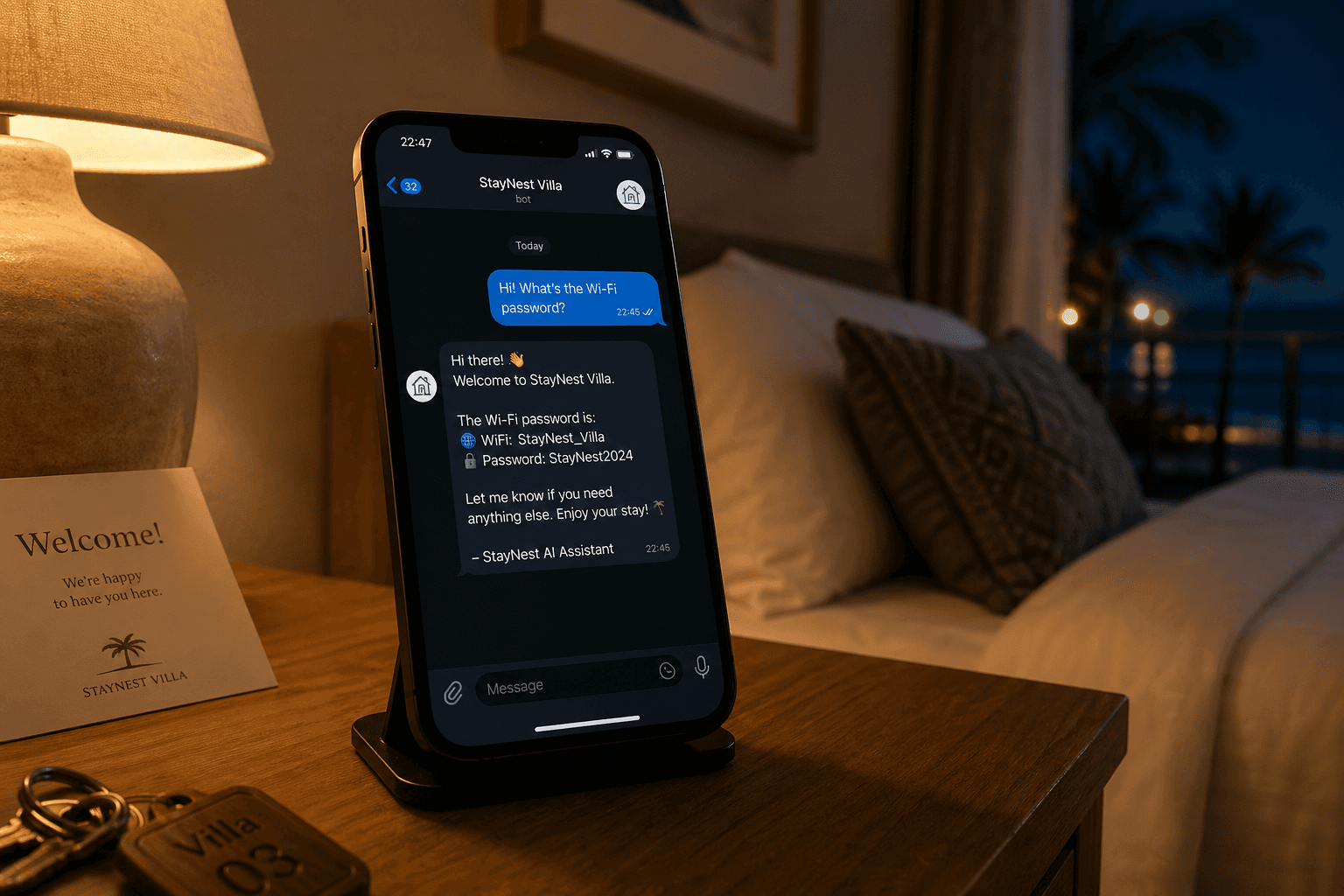
The 2am Message That Ruined Your Sleep Last Week
Most Airbnb hosts do not have a guest problem. They have a message problem.
The property runs fine. The cleaners show up. The reviews are decent. What wears hosts down is the steady drip of the same fifteen questions, asked by different people, at every hour of the day. What is the WiFi password? How do I work the coffee maker? Where do I park? Can I check in an hour early? Is there a supermarket nearby? Why is the hot water slow?
Airbnb's Superhost criteria require a first-message response rate of at least 90 percent within 24 hours, and in practice guests expect replies in minutes, not hours. That is a constant tax on your attention, and if you run more than one listing the tax compounds. This is exactly the kind of work an AI agent is built to absorb.
Why Most Host Automations Break
If you have already tried automated responders, you know the standard failure modes.
Rule-based templates miss context. A guest writes "the wifi isn't working," and the autoresponder sends the password they already have. A guest asks about parking, and the bot replies about trash day because the keyword matched.
Generic AI tools have no memory. ChatGPT does not know which property this guest booked. You have to paste the house manual into every conversation. The first few messages are fine, and then the context window fills up and answers get sloppy.
Existing short-term rental platforms are expensive and rigid. Hospitable, Hostaway, and Smartbnb bundle messaging with PMS features you may not need, and their AI add-ons often sit behind a higher tier.
A Telegram-hosted AI agent with persistent, per-property memory solves this differently. The agent reads the guest's question, looks up the specific property's data, answers in your voice, and only taps you on the shoulder when something genuinely needs you.
What a Good Messaging Agent Actually Does
A useful agent is not a glorified FAQ. It has five jobs.
1. Answer Repeat Questions Instantly
The boring 80 percent. WiFi, check-in time, door code, trash day, parking rules, AC controls, closest grocery store, late checkout policy. These are the messages that do not need your brain. Your agent handles them in under a minute, in the language the guest wrote in.
2. Keep Per-Property Memory
If you host more than one listing, a shared brain is useless. "Casa del Sol" has a pool with specific rules. "Loft Centro" has a fussy dishwasher and a parking spot labeled 4B. The agent needs a separate knowledge base per property that it loads before replying to a message from a guest in that listing.
3. Match Your Voice
Guests can feel when a reply is a template. A good agent is given examples of how you actually write: warm but brief, no exclamation marks, signed "J." at the end, English first then Spanish if the guest wrote in Spanish. Feed those examples in once, and the replies stop sounding like a help desk.
4. Escalate the Real Stuff
The point of automation is not to hide from your guests. It is to protect the 20 percent of messages that actually need you. Plumbing issues, lockouts, refund requests, safety concerns, anything with legal or reputational weight. The agent tags those, drafts an opening reply if appropriate, and pings you on Telegram with a summary so you can step in with full context.
5. Stay Inside Telegram
Telegram is already on your phone. It does not ask you to install another app, log into another dashboard, or pay a monthly seat fee per property. Every message, every escalation, every daily summary lands in the same chat window you already use for cleaners and co-hosts.
The Minimum Knowledge Base Per Property
Before your agent can answer anything, it needs to know the property. Think of this as a short, boring document you write once and update when things change. For each listing:
- Check-in and check-out times, plus your exact policy on early and late.
- Door code or key handoff process, and what to do if it fails.
- WiFi name and password, including the backup if you have a second router.
- Appliance quirks that guests actually ask about: coffee maker model and pod type, dishwasher start button, AC remote, hot water recovery time.
- House rules in plain language, not legal boilerplate.
- Neighborhood basics: nearest supermarket, pharmacy, ATM, two solid restaurants you actually like.
- Emergency contacts: plumber, electrician, the neighbor who has a spare key.
- Your voice examples: three or four real replies you have sent in the past.
That document is the agent's single source of truth. A Hermify agent loads it as a per-property skill, so the same agent can serve ten listings without mixing up which one it is talking about.
Practical Escalation Rules
Tell the agent in plain words when to stop answering and ping you. Rules that work well:
- "If the guest mentions water, leak, flood, smoke, smell of gas, fire, or blood, stop replying and alert me immediately."
- "If a guest asks for a refund, partial or full, draft a soft reply but do not send it. Summarize the request in a Telegram DM to me."
- "If a guest has written three times in the last hour, flag the conversation as high priority."
- "If a message is in a language not in the property's supported list, translate it, reply, and also show me what they said."
These rules are plain English. You do not write code. The agent enforces them because that is how its instruction prompt is set up.
A Real Example Conversation
Guest, 11:47pm: "Hey, we just got in. The code for the door isn't working."
Agent, 11:47pm: "So sorry, let me help. Please try 5829# and make sure you press the star first, not after. If that still fails, reply here and I will get the host on the line right away."
Guest, 11:49pm: "It worked, thanks!"
Agent, 11:49pm: "Great. The WiFi is 'Loft-Centro-5G' and the password is in the welcome folder on the kitchen table. There is bottled water in the fridge, and garbage goes out on Thursdays. Enjoy your stay."
You were asleep. Your guest was inside in under three minutes. No one paged you.
If the door code had not worked on the second try, the rule would have kicked in and the agent would have sent you a Telegram message: "Loft Centro, Guest Maria. Door code failing twice. Reservation ID 12-ABCD. Likely needs you to call."
What This Replaces
For a one-listing host: the mental load of being on call. You will still see messages, but you no longer have to respond to 80 percent of them.
For a five-listing host: a part-time virtual assistant. Most VAs are billed at 10 to 20 dollars per hour, and a busy month of guest messaging alone can eat 30 to 40 hours. A Hermes agent running on Hermify costs 12 dollars per month plus your own LLM API usage, which for this use case tends to land in the low single digits monthly.
For a ten-plus-listing operator: a genuine co-host. Not a replacement for the human you trust, but a layer underneath them that catches the routine and lets them focus on the messy cases.
Why Telegram Specifically
You already use WhatsApp for guests, probably. Telegram is for the back office. Your agent, your cleaners, your plumber, your co-host all fit neatly in one Telegram group or a set of channels. The Hermes agent lives in Telegram as a normal contact, answers in threads, and can be promoted or silenced per chat.
Guest-facing messages still happen inside Airbnb's own inbox so that reviews and reservation data remain tied to your listing. The agent reads those messages via a forwarding or integration layer and replies through the same channel. That way you keep your Superhost metrics clean.
Getting a Messaging Agent Running This Weekend
The fastest path:
- Write the per-property document for your busiest listing. One page is enough.
- Write four or five example replies in your own voice. Paste them in.
- Spin up a Hermes agent on Hermify. The setup takes about 60 seconds.
- Point it at your Telegram account and load the property document as its starting memory.
- Run it in shadow mode for the first week: the agent drafts replies, but you approve each one before sending. Use that week to correct its mistakes.
- After a week, flip it to auto-send for the clearly safe categories, and keep manual review for refunds, safety issues, and anything escalated.
In two weeks most hosts stop thinking about messaging at all. That is the point. You run the property. Your agent runs the inbox.
Sources
Run Your Own Hermes Agent
Bring your API key, connect Telegram, and get a self-improving AI agent live in 60 seconds.
Get Started