Hermes Agent Hosting vs Self-Hosting On A VPS
Comparing managed Hermes Agent hosting with self-hosting on a VPS: setup cost, maintenance burden, and what changes once the agent is live.
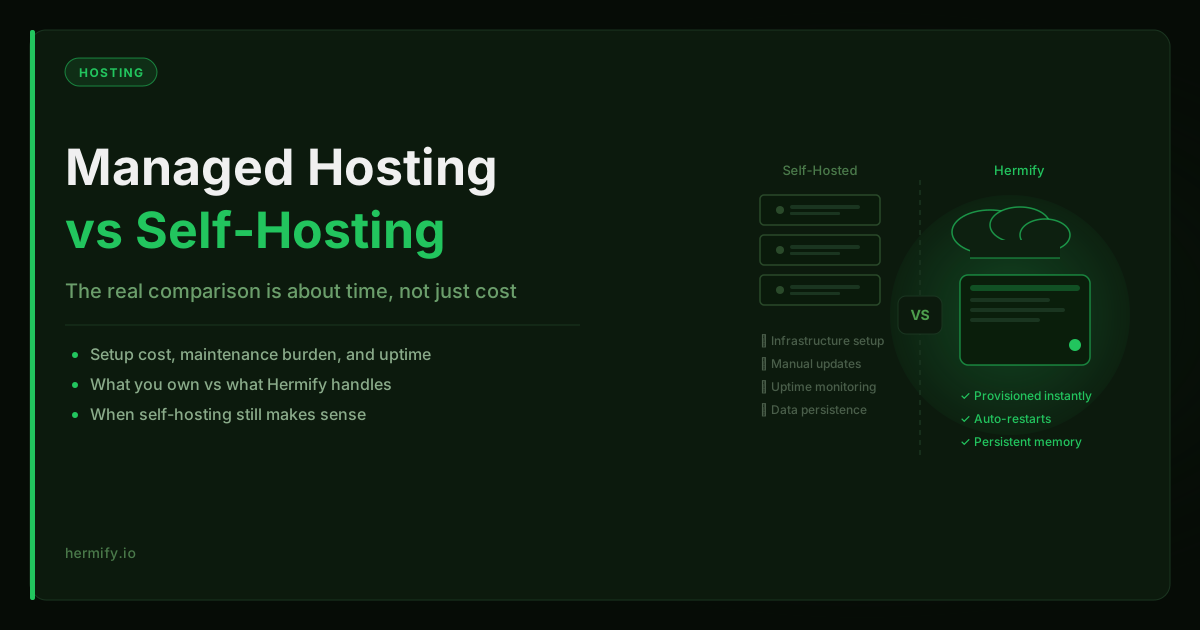
The Better Question Is About Time, Not Cost
Most people frame this as "can I self-host Hermes Agent?" That is the wrong question. Of course you can. The official project is fully open and flexible enough for self-deployment on any Linux server.
The right question is: "what am I signing up to manage after the first successful run?"
This guide answers that honestly, for both paths.
What Self-Hosting a Hermes Deployment Actually Involves
A self-hosted Hermes setup typically includes the following responsibilities:
Infrastructure selection. You need a server, a VPS from DigitalOcean, Hetzner, Linode, AWS, or similar. You choose the region, the size, and the provider. A minimal Hermes deployment runs comfortably on a 1GB RAM instance, but you will need more if you plan to run multiple subagents concurrently.
Runtime installation and configuration. Installing Hermes, configuring config.yaml with your provider keys and model settings, setting up the Telegram gateway (if you want messaging integration), and getting the process to start cleanly.
Secret management. Your model API key, Telegram bot token, and any other credentials need to be stored on the server securely. This usually means using environment variables or a secrets file that is not committed to version control.
Persistent data management. Hermes stores MEMORY.md, skill files, and user context in a data directory. If you are using Docker, you need a properly mounted volume. If the container is destroyed without preserving the volume, all accumulated memory and skills are lost.
Process management. The Hermes runtime and the messaging gateway need to stay running. This means setting up systemd services, a Docker restart policy, or a process supervisor. Without this, any server restart or process crash silences your bot until you manually restart it.
Update responsibility. When Nous Research releases a new version of Hermes, you decide whether and when to update, pull the new binary or image, and handle any configuration migration.
Uptime monitoring. Without something watching the process, you will only know the bot is down when you try to use it and it does not respond.
None of these steps is individually complex. Together, they represent an ongoing responsibility that you own entirely.
What Managed Hosting Changes
Managed Hermes hosting is not just "someone else's VPS." It is a productized deployment that removes the recurring infrastructure work from your plate.
With Hermify's managed hosting, the deployment model works differently:
- You provision through the onboarding flow, not through a server terminal
- Credentials are stored encrypted in the platform, not in a config file you maintain
- The runtime stays online because the platform manages the process, not because you set up systemd correctly
- Data persistence is handled via mounted volumes on every deployment, so your agent's memory survives container restarts and plan upgrades
- The Telegram gateway starts automatically as part of provisioning
The result is that you interact with the running agent, through Telegram and the dashboard, rather than with the server running the agent.
The Full Cost Picture
Self-hosting has a lower monthly invoice. That is real. But the invoice is not the full cost.
Self-hosted cost components:
- VPS: $4–$15/month depending on provider and size
- Model API usage: pay-as-you-go (typically $5–$20/month for regular use)
- Time for initial setup: 2–6 hours depending on Linux experience
- Time for ongoing maintenance: 30–60 minutes/month for updates, debugging, monitoring
Managed hosting cost components:
- Platform subscription: depends on plan (covers hosting, process management, data persistence)
- Model API usage: pay-as-you-go with BYOK, or bundled on higher plans
- Time for initial setup: 15–30 minutes
- Time for ongoing maintenance: near zero (status card in dashboard, one-click restart)
The math changes depending on how you value your time. If infrastructure maintenance is what you do anyway, self-hosting is a reasonable choice and the additional work is minimal. If you are a developer, researcher, or operator who wants to use the agent rather than babysit the server, managed hosting often has a lower total cost even when the monthly invoice is higher.
When Self-Hosting Makes Sense
Self-hosting is the better choice when:
You run this class of infrastructure already. If you have a homelab, an existing VPS with proper process management, or you manage Linux servers professionally, adding Hermes to your existing stack is low friction. The initial setup is a few hours, and maintenance slots naturally into your existing routines.
You need full runtime control. Self-hosting gives you complete access to the filesystem, logs, process environment, and configuration. If you are building custom integrations, extending Hermes's behavior at the code level, or need specific networking configuration, owning the runtime directly is necessary.
You are optimizing for experimentation. If you want to test different Hermes configurations, fork the project, or run multiple instances for comparison, a self-hosted VPS gives you that flexibility without plan constraints.
Your compliance or security requirements prohibit third-party hosting. Some organizations need full control over where their data lives. Self-hosting on infrastructure you control satisfies those requirements.
When Managed Hosting Makes Sense
Managed hosting is the better choice when:
You want Telegram deployment without operational complexity. The Hermes-on-Telegram experience requires the gateway to stay running continuously. This is easy to set up on managed hosting (it is part of the onboarding) and requires real server administration work to do reliably yourself.
The agent supports revenue or business-critical workflows. If you are using Hermes to handle recurring tasks that affect your business, downtime has real cost. Managed hosting with uptime monitoring and dashboard-triggered restarts is more appropriate than relying on a systemd unit you set up once and hope works.
You want the value of Hermes without the infrastructure expertise. Not every Hermes user wants to learn server administration. Managed hosting makes a production-grade deployment accessible to people whose expertise is in using the agent, not operating the infrastructure underneath it.
You are on Windows. Hermes does not support native Windows. Running it locally requires WSL2 (covered in the WSL2 guide), which is good for evaluation but not reliable for always-on Telegram access. Managed hosting eliminates the local machine requirement entirely.
The Deployment Decision Framework
| Scenario | Better Path |
|---|---|
| Already run Linux servers, want full control | Self-host on VPS |
| First Hermes deployment, want it working fast | Managed hosting |
| Want Telegram bot online 24/7 | Managed hosting |
| Building custom integrations or contributing to Hermes | Self-host for development |
| Using Hermes for business workflows | Managed hosting |
| Cost is the primary constraint | Self-host (lower invoice) |
| Time is the primary constraint | Managed hosting (lower total cost) |
The right answer depends on your specific situation. If you want to compare the two options side by side with current pricing, the Hermify hosting page covers what each plan includes and how the managed deployment compares to a DIY VPS setup.
If you are ready to skip the infrastructure work, the deploy Hermes Agent page walks through the full managed setup in under 30 minutes.
Run Your Own Hermes Agent
Bring your API key, connect Telegram, and get a self-improving AI agent live in 60 seconds.
Get Started