Hermes Agent vs Dify: Build or Run an Agent?
Dify and Flowise let you build LLM apps on a visual canvas. Hermes Agent is a finished runtime you just run. A 2026 comparison of both paths.
The Question Behind "Hermes Agent vs Dify"
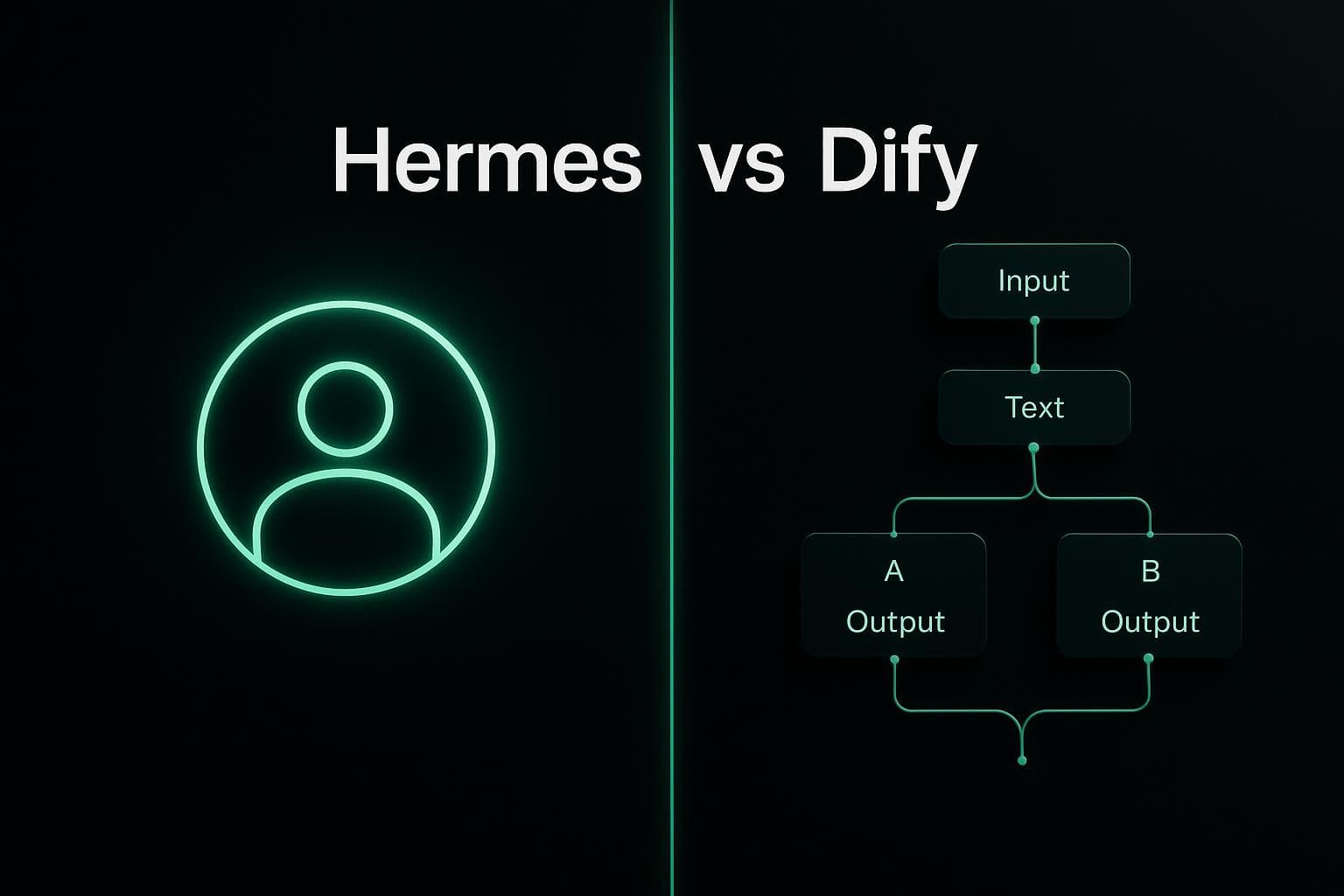
If you searched "hermes agent vs dify", you are standing at a fork that most comparison posts get wrong. These are not two versions of the same thing. Dify is a platform you use to build an agent. Hermes Agent is a finished agent you run. The choice is less "which tool is better" and more "do I want to assemble the agent myself, or do I want one that already works".
Dify - and its close cousin Flowise - belong to the low-code LLM-app builder category. You open a canvas, drag in nodes, wire up a model, a retrieval step, a tool call, and you ship a custom chat product. Hermes Agent is the opposite shape: an MIT-licensed runtime from Nous Research that installs in one command, brings persistent memory and 40+ tools out of the box, and starts talking to you on Telegram or Slack in minutes. This post draws the line clearly so you pick the right side of the fork.
What Dify Actually Is
Dify is an open-source LLMOps platform that packages a visual workflow builder, a RAG pipeline engine, an agent framework, model management, and observability into one interface. It is genuinely popular - well over 100,000 GitHub stars, millions of downloads, and a large library of production deployments.
The core capabilities are strong:
- A Prompt IDE and visual workflow canvas for orchestrating multi-step LLM apps.
- A RAG engine with full-text indexing and vector embeddings for knowledge bases.
- An agent node with Function Calling and ReAct-style reasoning.
- Support for 100+ model providers - OpenAI, Anthropic, Gemini, Mistral, Llama, and local models via Ollama.
- MCP support to reach external APIs, databases, and services.
On licensing, read the fine print. Dify ships under a modified Apache 2.0 license: free for most uses, but you may not run it as a multi-tenant service or remove the Dify logo from the console without a commercial license. For self-hosters that is usually fine, but it is not the no-strings MIT or Apache you might assume.
Pricing has two tracks. Self-hosting with Docker is free - you pay only for your VPS and your model tokens. Dify Cloud runs a Sandbox free tier, a Professional plan at $59/month, a Team plan at $159/month, and custom Enterprise pricing.
Where Flowise Fits
Flowise sits in the same category as Dify but leans lighter and more developer-flavored. It is built on LangChain, distributed under a clean Apache 2.0 license, and centers on a drag-and-drop canvas where blocks represent models, data sources, and tools.
Flowise gives you three building modes: Assistant (the beginner path), Chatflow (single-agent chatbots and simple LLM flows), and Agentflow (the superset for multi-agent systems and complex orchestration). It connects to OpenAI, Anthropic, Azure OpenAI, and local models via Ollama, and you can self-host it for free with Docker or Node.js, or use the managed Flowise Cloud.
For this comparison, treat Dify and Flowise as the same answer to the same question: a canvas where you assemble an LLM app yourself. Dify is the heavier, more product-complete platform with RAG and observability built in; Flowise is the lighter, LangChain-native builder. Neither is a running agent until you build one.

What Hermes Agent Actually Is
Hermes Agent is an MIT-licensed AI agent runtime, first released by Nous Research in early 2026. You install it once with a curl command on Linux, macOS, or WSL2, point it at any model provider with your own API key, and it runs as a long-lived process that messages you wherever you already are.
The shape is fundamentally different from a builder canvas:
- It is already an agent. No nodes to wire. Out of the box it ships 40+ tools, a persistent three-layer memory model, and a self-improving skills system that writes new skills from your past tasks.
- State is local and yours. Conversations, memories, and skills live in a SQLite database under
~/.hermes/, not in a managed store you rent by the gigabyte. - BYOK by design. OpenAI, Anthropic, OpenRouter, local models - swapping providers is a config change, not a rebuild.
- It meets you on messaging. Telegram, Discord, Slack, Signal, WhatsApp, email, and the CLI are first-class surfaces, no front-end to build.
- It speaks the OpenAI-compatible API, so anything that talks to OpenAI can talk to Hermes.
We covered how the memory and skills system accretes knowledge over weeks in the Hermes Agent memory and skills post, and the day-one install in Hermes Agent on Docker.
Build vs Run: The Core Difference
Here is the distinction that decides everything else. With Dify or Flowise, you are the author of the agent. You design the flow, choose the retrieval strategy, define each tool node, and own the result - a custom branded product shaped exactly the way you drew it. That control is the whole point, and it is real.
With Hermes, you are the operator of an agent that already exists. You do not design the loop; you configure a runtime that ships with reasoning, memory, tool use, and messaging already wired. You trade authorship for time-to-value: a personal agent that remembers you and runs on a $5 VPS today, instead of a canvas you spend a weekend assembling.
This is the same axis we drew in Hermes Agent vs LangChain - framework versus finished runtime - and in Hermes Agent vs n8n - visual workflow versus reasoning agent. Dify and Flowise land firmly on the build side.
Side by Side
| Question | Dify / Flowise | Hermes Agent |
|---|---|---|
| Category | Low-code LLM-app builder | Finished agent runtime |
| Mental model | You build the agent | You run the agent |
| Interface | Visual drag-and-drop canvas | Config file + messaging app |
| Time to a working agent | Hours of wiring per app | Minutes to first message |
| Persistent memory | You design it (RAG store) | Built in (core memory + skills) |
| End-user surface | You build the chat UI | Telegram, Discord, Slack, Signal, WhatsApp, CLI |
| Model choice | Many providers (Dify 100+) | Any provider via BYOK |
| License | Dify: modified Apache 2.0; Flowise: Apache 2.0 | MIT |
| Self-host cost | Free + VPS + tokens | Free + ~$5/mo VPS + tokens |
| Managed option | Dify Cloud / Flowise Cloud | Hermify |
| Best for | A custom branded LLM product with RAG | One always-on personal or team agent |
When Dify or Flowise Wins
There is a clear, honest case for the builder path, and it is not a consolation prize.
Pick Dify or Flowise when the deliverable is a product, not a personal assistant. If you are shipping a customer-facing chatbot with a branded UI, a curated RAG knowledge base, a defined conversation flow, and observability you can hand to a team, a visual builder is the right tool. You want to control every node because the behavior is the product.
Choose Dify specifically when you need the heavier platform: managed RAG ingestion, a prompt IDE, dashboards, and a path to a hosted Cloud tier. Choose Flowise when you want a lighter, LangChain-native canvas you can extend in code and self-host under a permissive Apache 2.0 license.
When Hermes Wins
Hermes is the right answer when you want an agent for yourself or your team, not a product for your users:
- You want a personal assistant that remembers context across weeks, not one chat session.
- You want it reachable on Telegram, Slack, or Signal without building a front-end.
- You want to swap model providers with a config change, never a rebuild.
- You want a predictable cost: a flat VPS plus your own model bill, not per-seat platform pricing.
- You want the agent to grow by writing its own skills, rather than you redrawing a flow each time the job changes.
For a managed Hermes runtime that takes about 60 seconds to set up on Telegram and bills a flat monthly rate, get started with Hermify - the same agent, the same memory model, with the VPS, updates, and monitoring handled for you.
They Are Not Mutually Exclusive
The cleanest insight is that these tools can compose. Because Hermes exposes an OpenAI-compatible endpoint, a Dify workflow or a Flowise chatflow can call Hermes as a model backend. You can build a branded RAG product on Dify for your customers and run Hermes as your own internal ops agent - they solve different problems and can sit side by side.
If you only need one, the question is simply this: are you building a product, or do you want an agent that works today?

How to Choose Without Regret
A short rubric:
- Building a customer-facing LLM product with RAG and a custom UI? Use Dify (heavier, more complete) or Flowise (lighter, LangChain-native). You want to own every node.
- Want one always-on personal or team agent that remembers you and lives in your messaging app? Use Hermes Agent. Self-host on a small VPS, or use Hermify to skip the ops entirely.
- Doing both? Build the product on Dify or Flowise, run Hermes as your internal agent, and let the Dify side call Hermes over its OpenAI-compatible API.
The framing that matters in 2026 is not "which has more nodes". It is whether you want to author an agent or operate one. Dify and Flowise make authorship pleasant. Hermes makes operation instant.
Sources
Run Your Own Hermes Agent
Bring your API key, connect Telegram, and get a self-improving AI agent live in 60 seconds.
Get Started