Track SEO Rankings With an AI Agent on Telegram
Stop paying $129/mo for rank tracking. Build a daily SERP digest on Telegram with an AI agent for under $1 - with cause-and-effect analysis.
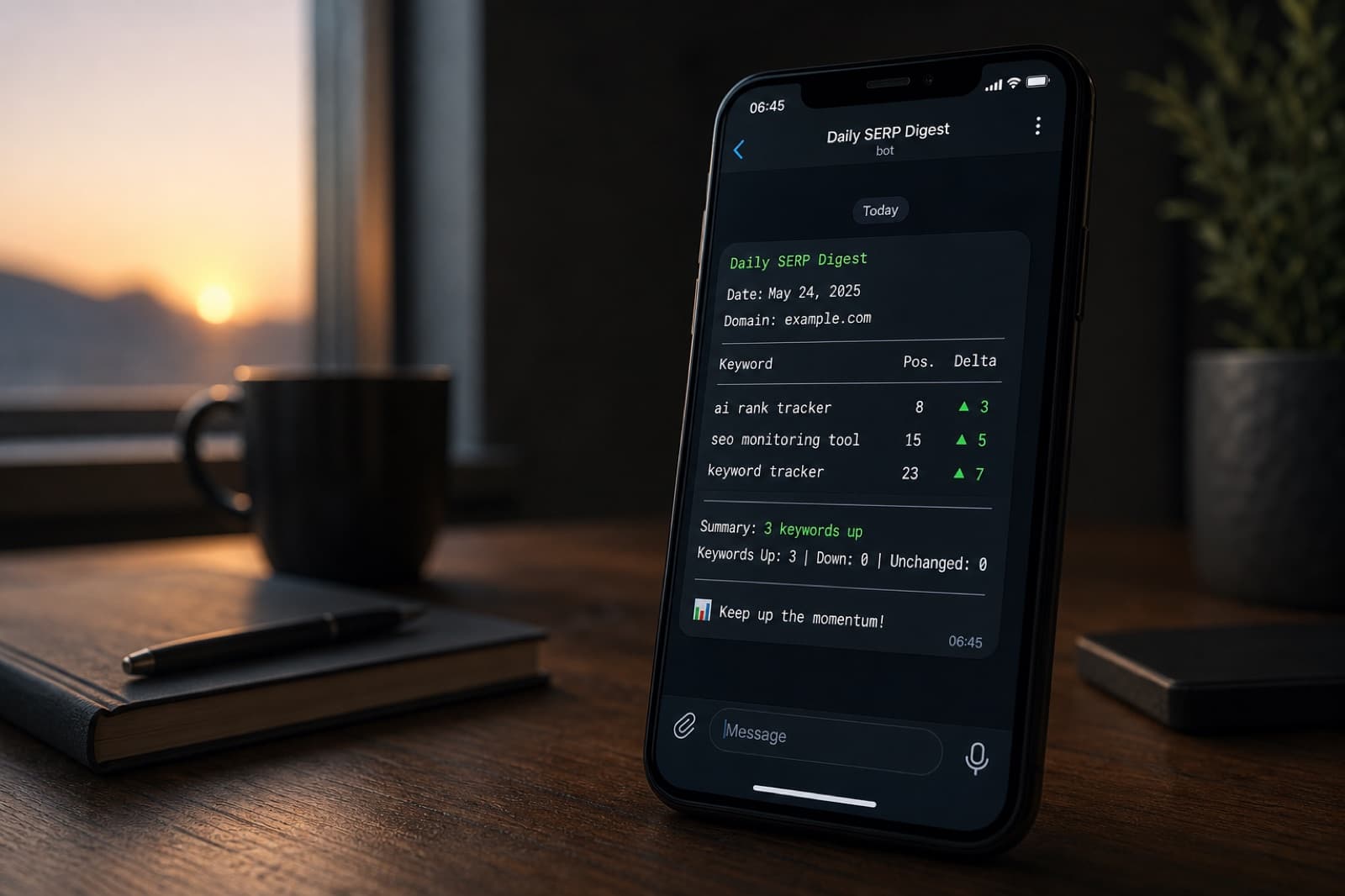
The Rank Tracker You Pay For Probably Tells You Less Than You Think
If you track 20 keywords, you have probably budgeted somewhere between $29 and $139 per month for the tool that tells you what page you sit on. Ahrefs Lite is $129/month and includes 750 tracked keywords. Semrush Pro starts at $139/month. Mangools is the budget option at $29/month. Whatever you picked, you log in once a week, you look at the position trend graph, you note that "core update" probably explains the drop, and you close the tab.
Now imagine you tracked the same 20 keywords for $0.36 a month instead, and instead of a graph you got a short message every morning that said: "you moved from position 8 to position 4 on 'self-hosted ai agent', the page that overtook you is from a new site that published yesterday, and your existing post is missing a Docker section their post leads with." That is a different product.
This post shows how to build that with a Telegram AI agent that polls a cheap SERP API every morning, diffs the result against yesterday, and writes a short narrative summary - not a chart - of what moved and the likely reason. The whole thing runs for under one dollar a month on 20 keywords daily.

The Three Layers You Actually Need
Rank tracking sounds like one job. It is really three, and most expensive tools bundle them into a UI that hides the cost of each.
- The raw SERP fetch. Hit Google for "your keyword" and get back the ten results. This is the part SaaS tools charge for. The actual underlying data costs almost nothing.
- The diff. Compare today's positions to yesterday's. Trivial code, no AI needed.
- The reasoning. "Why did this move?" That is the only part you need an LLM for, and you only need it on the keywords that actually changed.
Splitting the work this way is what brings the cost from $129 to under $1. The expensive part - the language model - only runs on the handful of keywords that moved in a given day, not on the full list, and not on every refresh.
The SERP Data Layer
You have three honest options for getting the raw SERP data.
Google Search Console API (free, your own site only). Google gives you query-level position data through the official Search Console API, including impressions, clicks, CTR, and average position. The catch: data lags 2-3 days, you only see your own verified properties, and you cannot watch a competitor's keyword. Good as a baseline. Not enough on its own.
DataForSEO Standard Queue ($0.0006 per query). Pay-as-you-go pricing, no monthly minimum after a $50 deposit. Standard Queue results average a 5-minute turnaround which is fine for a daily cron. At 20 keywords per day, 30 days a month: 600 queries x $0.0006 = $0.36/month. The Priority Queue at $0.0012/query and Live Mode at $0.002/query are there if you ever need them - you don't, for daily rank tracking.
Cheaper SerpApi alternatives. Serper, Searlo, and FlyByAPIs all undercut SerpApi's $7.25 per 1,000 searches by ten times or more, with Searlo at $0.30 per 1,000 and FlyByAPIs at $0.50 per 1,000. For a 20-keyword daily setup the difference is cents, so pick whichever has the response format your agent will parse most cleanly.
A reasonable default: DataForSEO Standard Queue for general SERP data, plus Search Console API for your own site as the ground-truth source. The combination costs less than a single SaaS rank tracker bills you for a single day.
The Agent Recipe: Three Chained Jobs
Same pattern as the crypto report build, same reason: keep the LLM out of the cheap polls, only wake it when something actually changed.
Job 1: Daily SERP poll, no LLM
A small script runs once at 6am. It loops over your tracked keywords, hits the SERP API for each, parses the top 20 results, and writes the result to a local JSON file. No AI is involved. No tokens are spent.
In Hermes terms this is a no_agent=True cron job. The agent does not wake up. The cron script runs, the data is saved, and the scheduler moves on. This is the entire cost layer.
hermes cron create "every day at 06:00" --no-agent \
  --script seo/fetch_serps.sh \
  --out memory/serp_today.json
Job 2: Diff and classify
A second job runs at 6:30am. It reads today's snapshot and yesterday's snapshot, computes per-keyword position delta, and classifies each change:
- No change (most keywords, most days) - skip.
- Small drift (1-2 position move) - log, don't ping the agent.
- Material move (3+ positions, fell off page 1, jumped onto page 1, or a new URL took your spot) - flag for the agent.
For a typical 20-keyword setup, you will have 2 to 4 material moves on a busy day and zero on a quiet day. That is the only thing the LLM ever sees.
Job 3: Agent writes the narrative
At 7am the agent wakes up. The input it gets is small: the list of material moves, yesterday's and today's top 5 results for each affected keyword, and the agent's memory of what you have shipped lately. The agent's output is the morning message you actually want.
hermes cron create "every day at 07:00" \
  --enabled-toolsets "memory,web_search" \
  --prompt "Summarize SERP changes from memory/serp_diff.json. \
            For each moved keyword, name the URL that gained position, \
            check if it is a new page, and propose one likely cause."
The enabled_toolsets flag is a Hermes cost control feature - the agent only loads memory and web_search for this job, no email or messaging tools, which keeps the context small and the inference cheap.
What a Useful Morning Digest Looks Like
Same discipline as the competitor monitoring digest: scannable, specific, ends with one suggested action. Example:
Daily SERP digest, June 13

Material moves (3):

- "self-hosted ai agent" - was #8, now #4. The page that fell off was a
  2024 Medium article. Your post on Hermes self-hosting moved up because
  Google now ranks newer technical guides higher for this query.

- "track seo rankings telegram" - was unranked, now #11. New site published
  June 11, already on page 2. Their post leads with a free Google Sheets
  template; yours does not.

- "ai agent docker" - was #3, now #6. The two pages above you are both
  from this week. Both include benchmark numbers; yours does not.

Suggested action for today:
Add a benchmark table to your Docker post. The competitive set has moved
toward concrete numbers and you are sliding because of it.
The "suggested action" is the part a chart cannot give you. It comes from the agent reading your existing posts, comparing them to what now ranks above them, and proposing one concrete change. That is what makes the digest worth opening.

What This Replaces, and What It Doesn't
This setup replaces the daily check-in part of Ahrefs, Semrush, and Mangools - the part that costs $29 to $139 a month and the part you actually use. It does not replace site audits, backlink analysis, content gap reports, or the keyword research stage. Those are real features you may still want a SaaS tool for, but you only need them weekly or monthly, not daily.
A reasonable hybrid: keep one cheap SaaS tier (Mangools at $29/month) for the occasional backlink check and keyword research session, run this Telegram agent daily for free-with-API-costs, and cancel the $129 tier. You save $100/month and your morning intelligence gets sharper because the agent reasons about your specific site instead of plotting a graph.
Setup in One Evening
A concrete list for this weekend:
- Spin up a Hermes agent on Hermify. Sixty seconds, then add your Telegram bot.
- Pick 15 to 25 keywords. Mix branded, money keywords, and a few you are trying to climb. Skip the head terms you have no chance on.
- Open a DataForSEO account. $50 minimum deposit, lasts months at this volume.
- Wire the three jobs. Cron at 6:00 (no_agent SERP fetch), 6:30 (diff), 7:00 (agent narrative to Telegram).
- Give the agent your existing blog posts as memory. Drop the URLs in a skill file or upload the markdown. This is the input that turns a position delta into a real suggestion.
- Run it for two weeks before judging. The first week is calibration. By week two the agent will know which keywords you actually care about and trim its messages accordingly.
Total setup time: about 90 minutes if you have your keyword list and your sitemap handy.
Why an Agent, Not Just a Script
You could write the diff job and pipe it to Telegram with a webhook in two hours. Lots of indie founders have. The script tells you which keyword moved. It cannot tell you the URL that overtook you is a five-day-old post, or that your own competing post is missing the section that post leads with. The reasoning step is where the AI agent earns its place.
There is also the memory dimension. After two months of daily digests, the agent has watched every keyword you track move several times. It knows which keywords are volatile (a 3-position swing on these is noise) and which are stable (a 1-position swing on these is signal). That tuning happens for free if the agent is running daily and writing to its persistent memory - it is impossible to replicate with a stateless script.
You cannot be on top of your rankings by checking them once a week in a dashboard. You can be on top of them by letting an agent watch them every day and hand you 10 minutes of signal at 7am.
Sources
Run Your Own Hermes Agent
Bring your API key, connect Telegram, and get a self-improving AI agent live in 60 seconds.
Get Started