AI Agent for Accountants: A Practical Guide for Small Firms
Solo and small-firm accountants do not need a $500/month bookkeeping platform. Here is how a practical AI agent fits a real practice in 2026.
The Real Problem in a Small Practice Is Not Data Entry
If you are a solo or small-firm accountant reading this, the headlines about AI in accounting probably do not match your day. The 2026 reports say 84 percent of accountants now use AI, the global AI accounting market is on track for $10.87 billion, and SME adoption is growing at a 44.6 percent compound rate. Meanwhile, 65 percent of accountants still report a lack of automation for routine tasks, and 61 percent say they are slowed by switching between too many tools. The gap is not access to better models. It is the gap between platforms built for the top 25 US firms and the day-to-day reality of a one-person or five-person practice.
This post is for accountants who want a practical answer, not a sales pitch. We will walk through what an "AI agent" actually means for a small firm, where the existing market lands on price and fit, what to look for if you are evaluating one, and how a self-hosted personal agent reachable from your phone compares with the platforms aimed at larger firms.
What an AI Agent Means for an Accountant
The phrase "AI agent" gets used loosely. For an accountant, it is useful to separate three things that all live under the same umbrella.
A bookkeeping engine sits inside QuickBooks Online, Xero, or a similar ledger and automates categorization, reconciliation, document extraction, and accounts payable. Docyt, Booke AI, and the bookkeeping side of Basis are the canonical examples. The workflow is familiar, the value is measurable in hours saved on month-end, and the price reflects that.
A firm-grade workflow platform runs on top of your engagements and is sold to mid-sized and enterprise firms. Basis, Truewind, and Zeni sit here. They handle close, advisory, audit-prep, and multi-entity consolidation, and they are priced for firms that bill enough hours for the cost to disappear behind the productivity lift.
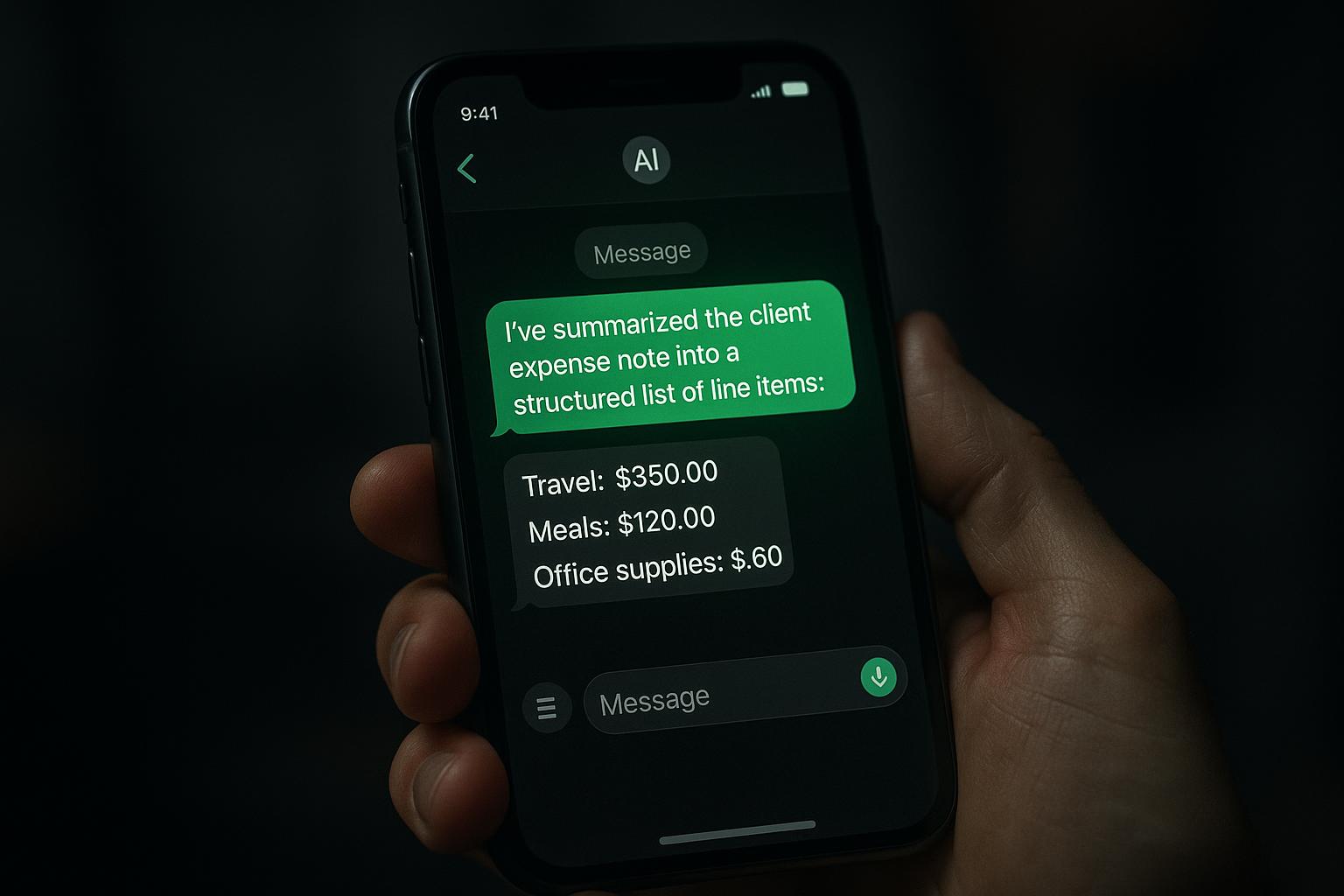
A personal agent is the one that is harder to find off-the-shelf and the one most solo accountants actually need. It does the work that does not look like "accounting": capturing voice notes after a client call and turning them into engagement summaries, drafting follow-up emails about missing receipts, tracking which client has not sent their monthly bank feed, reminding you that the quarterly estimate is due in 11 days. It lives where you already are, usually on your phone via a messaging app, and it remembers your practice across conversations.
The first two categories have a crowded market with clear pricing. The third is where most of the real time leaks in a small practice, and where the choice between a $15/month consumer tool and a $500/month bookkeeping platform leaves a wide gap that most accountants fall into.
The Market in 2026, Honestly
Before you pick anything, it is worth knowing what the price ladder actually looks like.
| Tool | Audience | Approximate Price | What It Does |
|---|---|---|---|
| Basis | Top-tier firms, CAS/Tax/Audit | Enterprise, custom pricing | End-to-end agents across the engagement lifecycle |
| Truewind, Zeni | Funded startups, growth firms | $299 to $2,000+ per month | Managed back-office bookkeeping with AI inside |
| Docyt | Small to mid-sized firms | Roughly $50 to $300 per month per client | OCR, AP automation, GARY assistant, month-end close |
| Booke AI | Bookkeepers, outsourced teams | Around $20 to $50 per client per month | Data entry, reconciliation, QBO/Xero login |
| QuickBooks Online with Intuit Intelligence | Anyone on QBO | From $19 per month | AI-powered bank feeds, categorization, reports |
| Xero Starter with AI features | Anyone on Xero | Around $29 per month | Invoicing, reconciliation, cash-flow forecasting |
| AutoEntry | Bookkeepers with variable volume | Credit-based, pay as you go | Document capture and publishing to ledgers |
| ChatGPT Plus, Claude Pro | Anyone | $20 per month | General-purpose, no ledger context |
Two things stand out. First, there is roughly a tenfold price gap between the consumer tools at the bottom and the managed back-office platforms at the top, and a much wider one between either of those and the enterprise platforms like Basis. Second, almost everything in this table targets a specific accounting workflow: bookkeeping, AP, close, advisory. Very little of it is built to be the agent that captures your day, remembers your clients, and follows up on the unglamorous loops that drain a small practice. That is not because the need does not exist. It is because the addressable market for "personal agent for a single accountant" is narrower than "bookkeeping engine for a 50-firm network," so the venture-funded products go where the seats are.
What to Actually Look For
If you are evaluating any AI for a small practice in 2026, the questions worth asking are the unglamorous ones.
Where does the data live, and who can see it? Client financial data is regulated under state board rules, IRS Section 7216 for tax preparers, and any applicable data-protection regime (GDPR in the EU, provincial law in Canada, state laws in the US). Model API providers all publish data-use terms and most offer enterprise tiers that exclude your prompts from training. Whatever you pick, you need to be able to answer the data-residency and confidentiality question concretely, not vaguely.
Does it remember anything between conversations? A lot of "AI for accountants" is a chat window with no memory. You re-paste the client context every time. For a personal agent that handles your practice, persistent memory across sessions is the feature that turns it from a fancy autocomplete into something useful.
Can you bring your own model and your own keys? BYOK is the difference between paying $30 per month and paying for the actual tokens your usage consumes, plus the freedom to switch providers when one of them changes terms. For a one-person practice the API costs are usually a few dollars a month at most.
Where does it run? A hosted SaaS is convenient. A self-hosted runtime running on a $5 VPS or your own machine is more private and removes vendor lock-in. The trade-off is one evening of setup against ongoing flexibility. For the kind of always-on personal agent you want hooked into your phone via Telegram, Signal, or WhatsApp, self-hosted is increasingly the practical default. Our post on the pricing math behind self-hosted vs managed Hermes Agent walks through the actual numbers.
Does it do anything outside the ledger? The best return on time for a small firm is usually not faster reconciliations. It is the agent that captures your post-meeting voice notes, drafts the "we still need your March statements" email, schedules the quarterly check-in, and flags which client has gone quiet. None of the big accounting-AI brands cover that surface end to end.
Where a Self-Hosted Personal Agent Fits
Hermify is one option for the third category, the personal-agent piece. It is an MIT-licensed runtime you self-host, you connect to your own model provider with your own API key (OpenAI, Anthropic, OpenRouter, or others), and you talk to it through Telegram, Signal, WhatsApp, Slack, or email - whichever messaging app already lives on your phone. It keeps a persistent memory across conversations, so when you say "follow up with the client whose Q1 books we closed last week," it knows which client, which engagement, and which loose ends remain. You can read the broader concept in our post on persistent memory in an AI assistant.
For an accountant the practical shape looks like this:
- Expense and note capture. You walk out of a client meeting, send a 90-second voice note. The agent transcribes it, drafts the email asking for the missing receipts, and saves the engagement notes to that client's memory.
- Client cadence. A client has gone 14 days without sending their bank feed export. The agent surfaces it, drafts the next nudge, you hit send. The unsexy follow-up loop that drives most month-end stress.
- Monthly close handoff. You mention "closed April for Acme this morning." The agent logs it, schedules the variance review for the 5th, and queues the next month's checklist.
- Tax-deadline reminders. Quarterly estimates, sales-tax filings, payroll deposits. The agent keeps the per-client deadline map and pings you a week out.
- Ledger and document work stays where it is. For actual bookkeeping you keep using QuickBooks, Xero, Docyt, or Booke. A personal agent is not a substitute for a ledger; it is the layer that wraps your day around it.

The cost profile is also different from the dedicated platforms. A $5 VPS plus a few dollars a month in model API usage is a normal monthly bill for a single-accountant setup. The trade-off is that you spend an evening with the docs to set it up, instead of clicking "Subscribe." For accountants who are privacy-sensitive or who handle client data under strict confidentiality obligations, that trade-off is usually worth it. For accountants who want zero setup, Docyt for bookkeeping automation and QuickBooks with Intuit Intelligence are the obvious commercial paths and they are good at their jobs.
A Workable Stack for a Solo Practice
You do not have to pick one tool and call it your "AI strategy." A practical 2026 stack for a one-accountant or small-firm practice often looks like this:
- A ledger with AI inside it for the actual books. QuickBooks Online with Intuit Intelligence or Xero with its AI features is the default for most clients.
- A bookkeeping accelerator when document volume justifies it. Docyt for end-to-end close automation, Booke AI for data-entry-heavy outsourced work, AutoEntry for variable volume.
- A practice-management layer for engagement tracking, billing, and client portals. Karbon, TaxDome, or whatever your firm already uses.
- A personal agent that lives on your phone, captures your day, drafts your follow-ups, and remembers your clients. This is where a self-hosted runtime like Hermify fits, or any of the consumer chat tools if you are willing to live without persistent memory.
You do not need to decide everything at once. Start with the layer that costs you the most time. For most solo accountants, that is the personal-agent layer, because the ledger market is well-served and the bookkeeping-automation market is well-served, and the layer that captures your day is the one that has been ignored.
Get started with Hermify if a self-hosted personal agent is the layer you want to try first - you keep your data, you keep your model choice, and you keep the agent that remembers your practice.
What This Does Not Solve
An AI agent does not sign off on a tax return for you, does not replace your duty of professional skepticism, and does not eliminate the need to actually read the bank statements. State boards and the AICPA have been clear that the duty of due care applies to AI output: you are responsible for what you file, regardless of which model drafted it. Use any agent the same way you would use a competent first-year staffer - useful, fast, and double-checked.
It also does not replace the relationships that win clients and retain them. The five touches it takes to convert a referral, the time you spend on the phone with a worried client during an IRS notice, the hour you spend explaining a P&L to an owner who does not read financial statements - none of that is automatable in 2026, and probably will not be for a long time. What an AI agent does is buy you the time to do those things, by absorbing the surrounding administrative weight.
Sources
- Top 9 AI Agents in Accounting in 2026 - AIMultiple Research
- Top 14 Accounting AI Agents - AIMultiple
- Basis scales accounting by turning OpenAI model progress into trusted agents - OpenAI
- AI Adoption Accelerates in Accounting, Yet Fragmented Tools Keep Efficiency Just Out of Reach - Progress Software / GlobeNewswire
- 10 Best AI Bookkeeping Software 2026 - Tofu
- Booke.ai Review 2026 - Accounting AI Tools
- AI in Accounting: The Complete 2026 Guide - DualEntry
Run Your Own Hermes Agent
Bring your API key, connect Telegram, and get a self-improving AI agent live in 60 seconds.
Get Started