AI Agent for Consultants: A Practical Guide for 2026
Independent consultants do not need an enterprise agent platform. Here is what an AI agent actually does for a small practice in 2026.
The Real Problem in a Solo Practice Is Not Slide Decks
If you run an independent consulting practice in 2026, the noise around AI consulting probably does not match your week. Sia Partners now operates 800+ agents in its internal Agent Store. Suits.ai is selling firm-wide agent platforms to professional services groups. RSM, Centric, and the Big Four are publishing agentic transformation playbooks aimed at clients with eight-figure budgets. Meanwhile, you are a one-person or three-person shop. Your bottleneck is not "we need 400 specialized agents." Your bottleneck is the meeting note you did not write up, the follow-up email you did not send, the proposal that has been sitting in drafts for nine days, and the engagement context you keep losing between Monday and Thursday.
This post is for consultants who want a practical answer, not a sales pitch. We will walk through what an "AI agent" actually means for a solo or boutique practice, what the market looks like at your end of the price ladder, what to evaluate before you buy anything, and how a self-hosted personal agent reachable from your phone compares with the platforms aimed at firms 100 times your size.
What an AI Agent Means for an Independent Consultant
The phrase "AI agent" gets used loosely. For a consultant, it helps to separate three things that all sit under the same umbrella.
A firm-grade agent platform runs at the firm scale: pre-sales, engagement orchestration, deliverable generation, knowledge management across every consultant. Sia Partners' Agent Store, RSM's agentic services, the Centric AI Agent Development practice, and the bookings inside the Big Four all live here. They are real, they are powerful, and they are designed for organizations that bill enough to absorb seven-figure platform investments.
A consulting-firm SaaS sits one tier down: Suits.ai is the canonical example, plus the Ema-style horizontal agent platforms being adapted to professional services. These are aimed at boutique-to-mid-market firms with 10 to 200 consultants, with proposal generation, engagement memory, and methodology capture as the headline features. Pricing is not public, but enterprise SaaS in this space is rarely under $20,000 per year per firm.
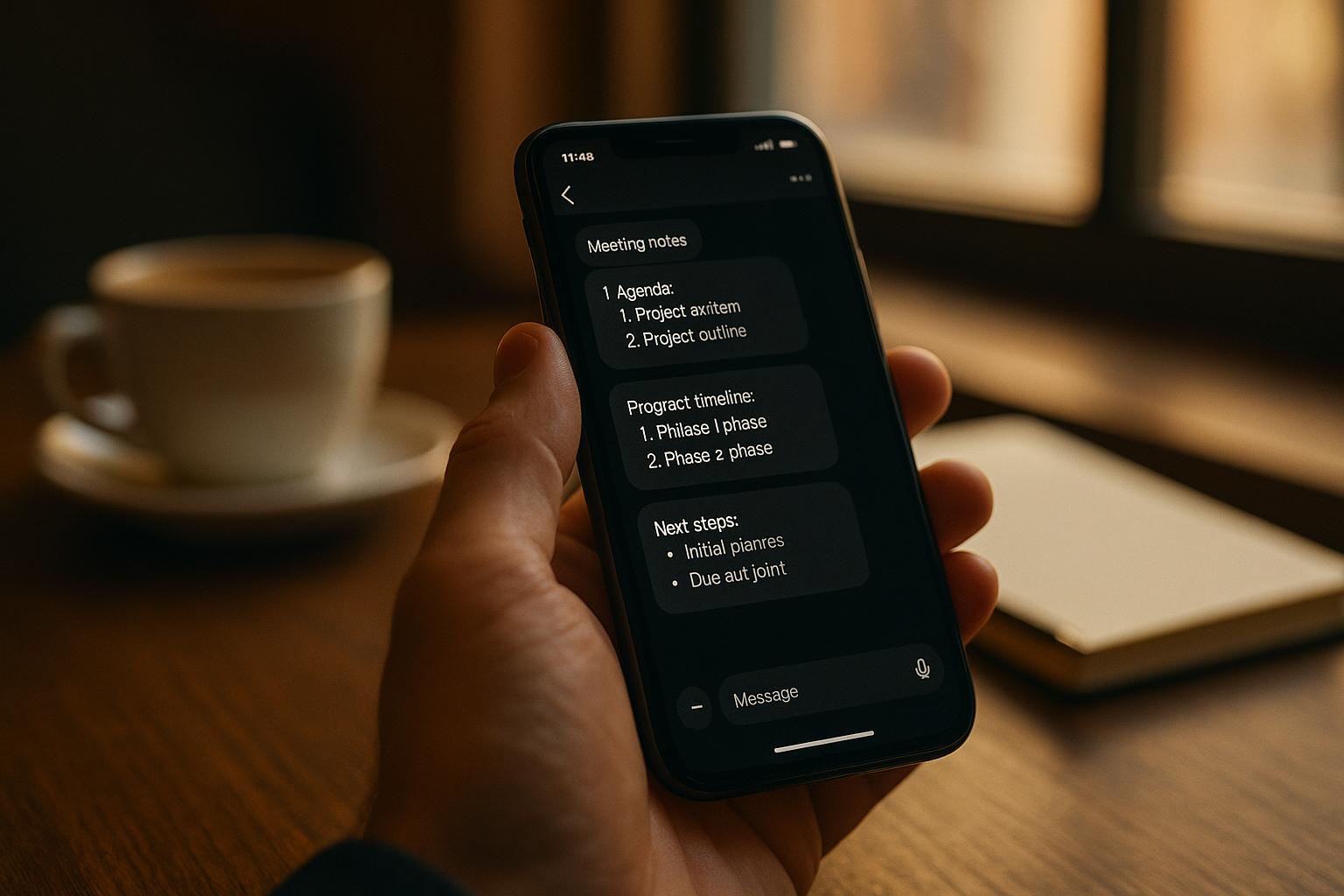
A personal agent is the one most independents actually need and the one hardest to find off-the-shelf in the right shape. It captures the Friday afternoon voice memo about the client call, drafts the follow-up email in your voice, remembers that the COO at Acme is the decision-maker but the CFO controls the budget, schedules the quarterly review, and pings you when you have not heard from a key client in two weeks. It lives where you already are, usually a messaging app on your phone, and it remembers your practice across conversations.
The first two categories have a crowded enterprise market. The third is where most of a solo consultant's time leaks, and it is the gap between a $20/month ChatGPT Plus seat and a $20,000/year firm platform that most independents fall into.
The Market in 2026, Honestly
Before you pick anything, it is worth knowing what the price ladder actually looks like for a consulting use case.
| Tool | Audience | Approximate Price | What It Does |
|---|---|---|---|
| Sia Agent Store, Big Four agentic platforms | Global firms, 1000+ consultants | Custom enterprise pricing | 400 to 800+ specialized agents across industries and functions |
| Suits.ai | Boutique-to-mid-market consulting firms | Enterprise SaaS, not public | Proposal generation, methodology capture, engagement memory |
| Ema-style horizontal agent platforms | Mid-market companies | $20K+ per year, by seat | General-purpose enterprise agents adapted per function |
| Fathom, Fireflies, Otter | Anyone with calls | $0 to $30 per user per month | Meeting transcription, summary, action items |
| Elephas, Reflect, Mem | Independents wanting per-client memory | $14 to $20 per month | Per-client knowledge bases and prompt-driven recall |
| Claude Pro, ChatGPT Plus | Anyone | $20 per month | General-purpose chat, no persistent client context |
| MindStudio, n8n, Zapier with AI | Builders | $20 to $100+ per month | Workflow automation around the agent core |
| Self-hosted runtime on a $5 VPS | Privacy-sensitive independents | ~$5 VPS + a few dollars in API usage | Personal agent on your messaging app, BYOK, persistent memory |
Two patterns stand out. First, a complete solo-consultant AI stack in 2026 typically lands between $50 and $150 per month. The ones reporting the largest time savings (8 to 15 hours per week) are not the most expensive ones; they are the most coherent ones, where the meeting tool, the writing tool, the client memory, and the workflow tool actually feed each other instead of living in separate browser tabs. Second, the tools that solve the personal-agent layer best for an independent consultant are almost never the ones marketed as "AI for consulting." The big "AI for consulting" brands target firms with hundreds of seats, not your practice.
What to Actually Look For
If you are evaluating any AI for an independent consulting practice in 2026, the questions worth asking are the unglamorous ones.
Where does the data live, and who can see it? Client information is regulated under your engagement letter, NDAs, sometimes industry rules (financial services, healthcare, regulated public-sector clients), and any applicable data-protection regime. Model API providers all publish data-use terms, and most offer enterprise tiers that exclude your prompts from training. Whatever you pick, you need to be able to answer the data-residency and confidentiality question concretely when a client procurement team asks, not vaguely.
Does it remember anything between conversations? A lot of "AI for consulting" is a chat window with no memory. You re-paste the engagement context every time. For a personal agent that handles your practice, persistent memory across sessions is the feature that turns it from a fancy autocomplete into something useful. Per-client context (industry, stakeholders, prior recommendations, current open loops) is where the compounding value lives.
Can you bring your own model and your own keys? BYOK is the difference between paying $30 per month flat and paying for the actual tokens your usage consumes, plus the freedom to switch providers when one of them changes terms. For a one-person practice the API costs are typically a few dollars a month. Our BYOK setup guide walks through what this looks like in practice.
Where does it run? A hosted SaaS is convenient. A self-hosted runtime on a $5 VPS or your own machine is more private, removes vendor lock-in, and survives the next pricing change. The trade-off is one evening of setup against ongoing flexibility. For the kind of always-on personal agent you want hooked into your phone via Telegram, Signal, or WhatsApp, self-hosted is increasingly the practical default. Our post on the pricing math behind self-hosted vs managed Hermes Agent walks through the actual numbers.
Does it do anything outside the deliverable? The best return on time for an independent is rarely a faster slide deck. It is the agent that captures your post-meeting voice notes, drafts the next nudge to a quiet client, schedules the quarterly check-in, and flags the engagement that has gone cold. None of the firm-grade platforms cover that surface end to end for a one-person shop.
Where a Self-Hosted Personal Agent Fits
Hermify is one option for the third category, the personal-agent piece. It is an MIT-licensed runtime you self-host, you connect to your own model provider with your own API key (OpenAI, Anthropic, OpenRouter, or others), and you talk to it through Telegram, Signal, WhatsApp, Slack, or email - whichever messaging app already lives on your phone. It keeps a persistent memory across conversations, so when you say "follow up with the client whose Q1 strategy session we ran last week," it knows which client, which engagement, and which loose ends remain. You can read the broader concept in our post on persistent memory and skills in an AI assistant.
For an independent consultant the practical shape looks like this:
- Meeting capture and follow-up. You walk out of a discovery call, send a 90-second voice note. The agent transcribes it, drafts the recap email with the action items, and saves the engagement notes to that client's memory.
- Client cadence. A prospect has gone 12 days without responding to your last proposal. The agent surfaces it, drafts the next nudge, you hit send. The unsexy follow-up loop that decides who closes deals and who does not.
- Stakeholder map. You mention the new VP of Operations at a client. The agent updates the stakeholder map, notes the reporting line, and flags that they were not in the original kickoff.
- Engagement deadlines. Steering committee dates, deliverable milestones, contract renewals. The agent keeps the per-engagement deadline map and pings you a week out.
- Deliverable work stays where it is. For the actual decks and models you keep using PowerPoint, Notion, Excel, or whichever tools your client expects. A personal agent is not a substitute for your delivery tools; it is the layer that wraps your day around them.

The cost profile is also different from the firm-grade platforms. A $5 VPS plus a few dollars a month in model API usage is a normal monthly bill for a single-consultant setup. The trade-off is that you spend an evening with the docs to set it up, instead of clicking "Subscribe." For consultants who handle client information under strict confidentiality obligations, who work across multiple regulated industries, or who simply do not want a third-party SaaS sitting between them and their engagement notes, that trade-off is usually worth it. For consultants who want zero setup and are happy with a managed hosted runtime, Hermify's hosted tier gives you the same agent without the VPS step.
A Workable Stack for an Independent Practice
You do not have to pick one tool and call it your "AI strategy." A practical 2026 stack for a one-consultant or small-firm practice often looks like this:
- A meeting note layer. Fathom, Fireflies, or Otter for call transcription, summary, and action items. Free tiers usually cover a single consultant's call volume.
- A model provider with BYOK. A paid OpenAI, Anthropic, or OpenRouter account so the rest of the stack can call a real model with your terms, not a SaaS reseller's.
- A personal agent layer that lives on your phone, captures your day, drafts your follow-ups, and remembers your clients across sessions. This is where a self-hosted runtime like Hermify fits.
- A workflow layer when you outgrow point-and-click. MindStudio, n8n, or a few scheduled tasks against your agent for recurring research (competitor monitoring, market scans, weekly newsletter drafts).
- A delivery layer you already own. Slides, docs, spreadsheets, the CRM your clients expect. Do not let an AI vendor convince you to migrate the work itself; let the AI sit alongside it.
You do not need to decide everything at once. Start with the layer that costs you the most time. For most independent consultants that is the personal-agent layer, because the meeting-note market is well-served and the model-provider market is well-served, and the layer that captures your day and remembers your clients is the one that has been ignored.
Get started with Hermify if a personal agent on your phone is the layer you want to try first - you keep your data, you keep your model choice, and you keep the agent that remembers your engagements across the year.
What This Does Not Solve
An AI agent does not run the discovery call for you, does not replace your judgment in front of a client, and does not eliminate the need to actually understand the engagement. Clients in 2026 increasingly expect implementation rigor from independents, not handoff slide decks - one McKinsey-cited stat puts 65 percent of generative-AI buyers as preferring consultants who participate in implementation, not just strategy. Use any agent the same way you would use a competent junior consultant: useful, fast, and double-checked.
It also does not replace the relationships that win and retain consulting work. The five touches it takes to convert a referral, the 45-minute call where a worried executive needs to be heard before they need an answer, the dinner that decides next year's renewal - none of that is automatable in 2026, and probably will not be for a long time. What an AI agent does is buy you the time to do those things, by absorbing the surrounding administrative weight that makes a solo practice exhausting.
Sources
- Top 10 AI Consulting Companies 2026 - LeewayHertz
- Top AI Consulting Firms and Companies in 2026: Big Four vs Boutique vs Solo - Bushe
- AI Agents For Solopreneurs Are Reshaping The One-person Business - SelfEmployed
- Sia Reaches a New Milestone with Over 800 Agents in its Agent Store - Sia Partners
- Suits.ai: AI Agents for Consulting and Agencies
- The Solo Consultant AI Stack Guide (2026) - Elephas
- 5 Best AI Note Takers for Consulting Meetings in 2026 - Plaud
- 20 Best AI Tools for Consultants 2026 - Carly
Run Your Own Hermes Agent
Bring your API key, connect Telegram, and get a self-improving AI agent live in 60 seconds.
Get Started