AI Assistant for Contractors: A Practical 2026 Guide
Most contractor AI is sold to enterprise GCs on ProCore-class budgets. Here is what an AI assistant actually does for a one-truck contractor in 2026.
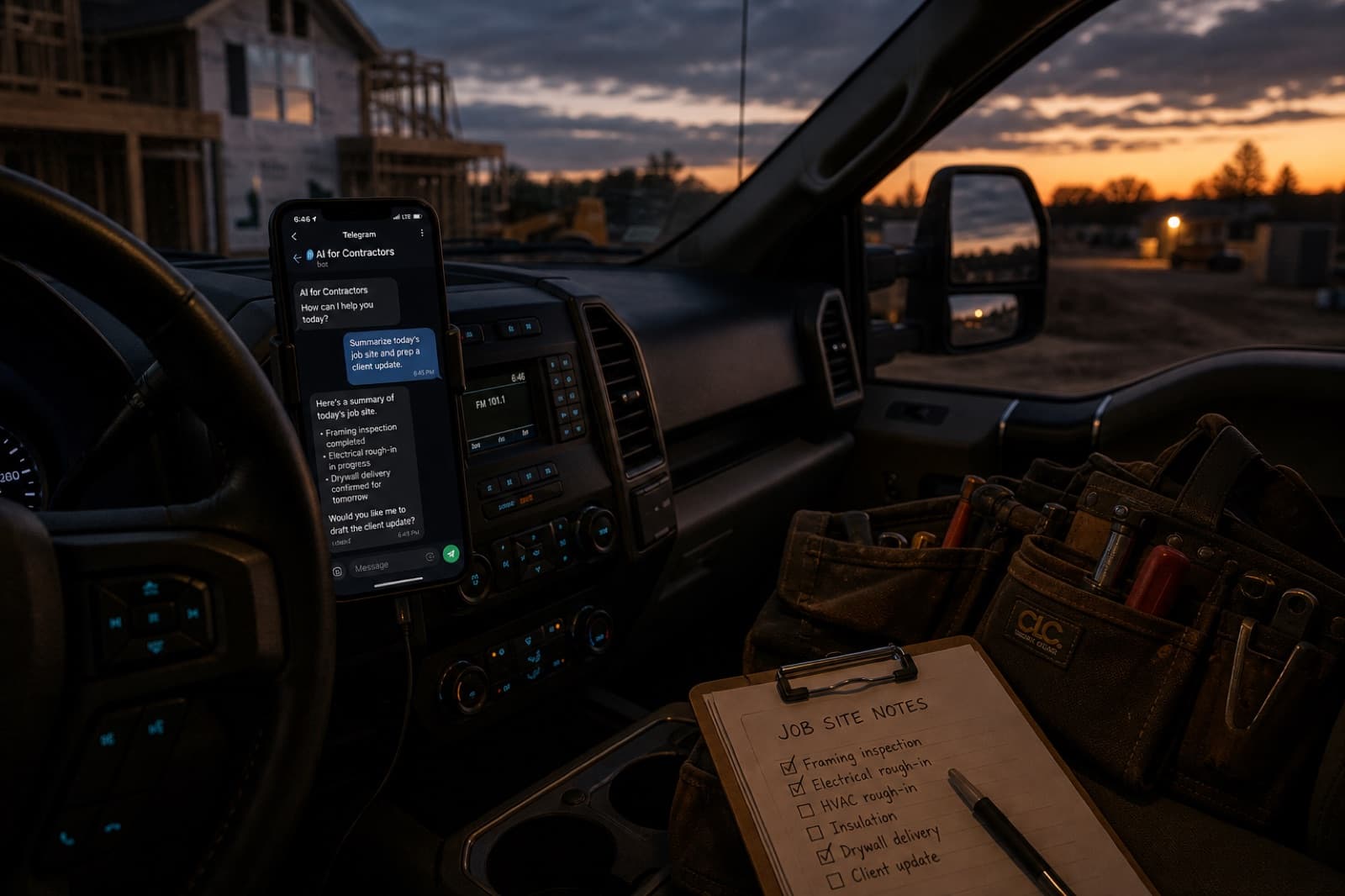
The Real Problem on a Contractor's Day Is Not the Crew, It Is the Paperwork
If you run a one-truck contracting business or a small crew in 2026, the AI pitch you keep hearing probably does not match your week. Klutch markets a fleet of "field-trained AI agents" for built-world enterprises. Velora reads your WhatsApp construction groups and produces structured cost and schedule control for project managers. Banamind pulls voice notes from your team into project plans and generates invoices for the GC running ten sites. Meanwhile you are bidding the next driveway from your truck cab, chasing a roofing customer who has not paid in 47 days, trying to remember which supplier promised the cabinet delivery window for Tuesday, and answering a missed text from a homeowner who wants a quote on a deck before her husband gets home.
The administrative weight around the work is the actual bottleneck. According to a 2025 Sage study of UK small businesses, two days of every month go to financial admin like chasing invoices and late payments - call it 13 months of work for 12 months of pay. Manual systems cost around $4,800 per employee per year in lost productivity and errors. For a contractor on the tools all day, that lost time does not come out of bench hours; it comes out of evenings, weekends, and the bid you never got to. This post is for working contractors who want a practical answer, not an enterprise sales pitch. We will walk through what an "AI assistant" actually means for a contractor in 2026, what the market looks like at the small-crew end of the price ladder, what to evaluate before you buy anything, and how a self-hosted personal agent reachable from your phone compares with the platforms aimed at GCs running fifty sites.
What an AI Assistant Means for a Contractor
The phrase "AI assistant for contractors" gets used loosely. For a one-truck or small-crew contractor, it helps to separate three things that all sit under the same umbrella.
An enterprise construction agent platform runs the project-management layer for a GC: document control, permit review, bid leveling, jobsite oversight, warranty management. Klutch's Bob AI captures punch items and daily updates through SMS, WhatsApp, and Telegram. Velora turns construction WhatsApp groups into structured progress, blockers, and quality control. These tools work for the shape of business they are sold to: GCs with five to fifty active jobs, project managers who already spend their day inside coordination software, and the budget to match.
A field-service platform with embedded AI sits one tier down: Jobber, Housecall Pro, ServiceTitan, and the AI features inside FieldEdge or BuildOps. These bundle scheduling, dispatch, invoicing, and a CRM with growing AI capability around quote generation, customer follow-up, and call summary. Pricing ranges from roughly $50 to $400 per month per seat depending on the tier and the trade. They are valuable when your day is already centered on dispatch and invoicing through a single tool.
A personal AI assistant is the one most one-truck and small-crew contractors actually need, and the hardest to find packaged in the right shape. It captures the 90-second voice note you record between jobs, drafts the follow-up text to the homeowner who asked about a deck, remembers that the Bensons owe $3,200 from the bathroom remodel and have not paid in 47 days, pings you Monday morning about the supplier who promised a Tuesday cabinet window, and lives on your phone inside the same chat app where your customers and crew already message you. It does not replace your accounting software and it does not replace your scheduling tool. It absorbs the surrounding admin layer that pulls the energy out of running the business.
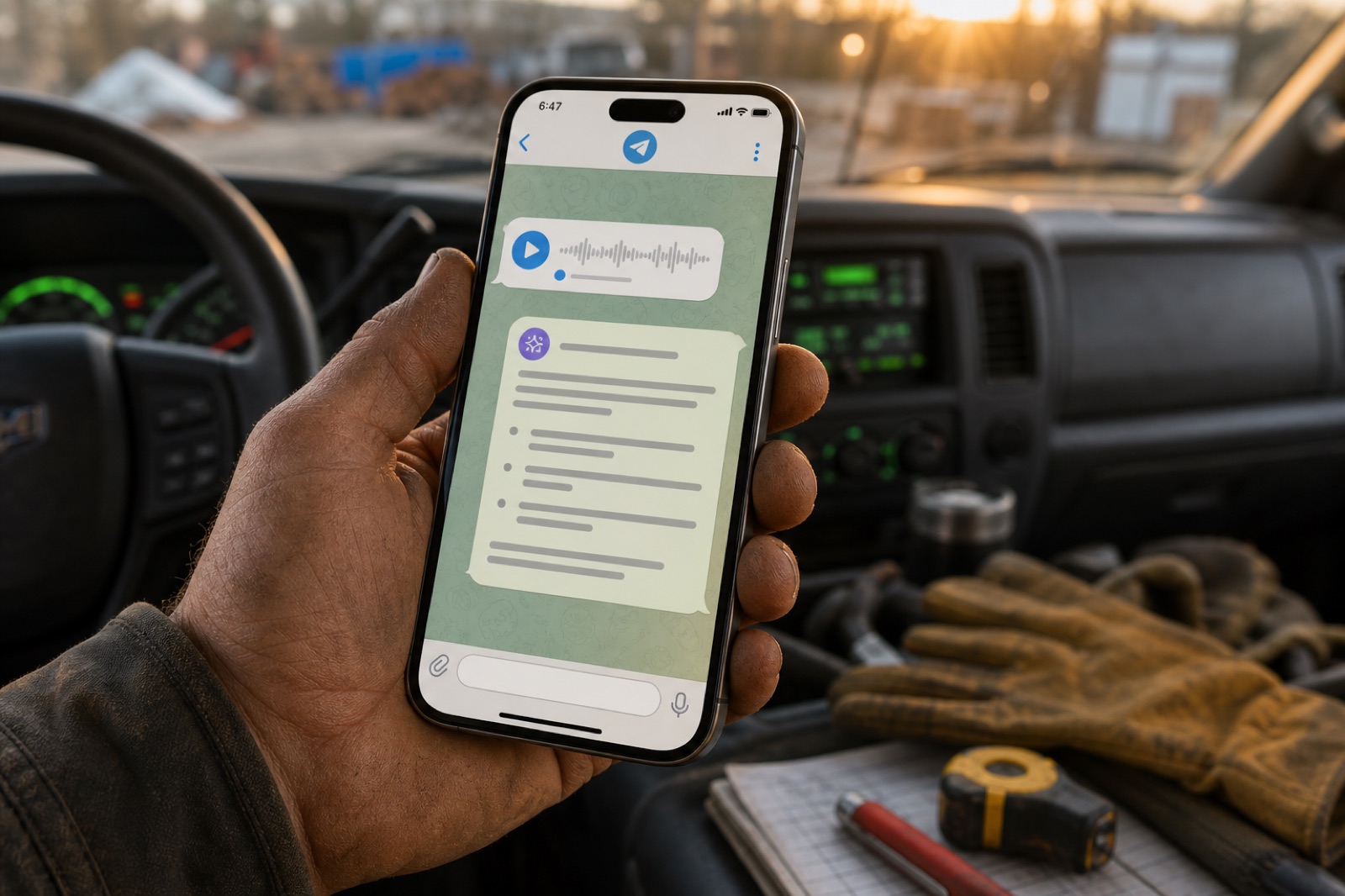
The first two categories have established markets aimed at GCs and field-service operators. The third is where most of an individual contractor's time leaks, and it is the gap between a $20 per month ChatGPT Plus subscription and a $250 to $400 per month field-service platform that most small contractors fall into.
The Market in 2026, Honestly
Before you pick anything, it is worth knowing what the price ladder actually looks like for a one-truck or small-crew contractor.
| Tool | Audience | Approximate Price | What It Does |
|---|---|---|---|
| Klutch AI, Banamind, Velora | GCs and construction PMs with multiple active sites | Custom enterprise pricing, often four figures per month | Project-wide AI: documents, schedule, cost, quality |
| ServiceTitan, BuildOps | Mid-size service and specialty contractors | $250 to $400+ per user per month | Full field-service platform with embedded AI |
| Jobber, Housecall Pro, FieldEdge | Owner-operators and small crews | $50 to $200 per month | Scheduling, dispatch, invoicing, CRM, lighter AI |
| Construction Ninja, Heyloha, SendStatus | Crews coordinating on WhatsApp | $30 to $100 per month per crew | WhatsApp-native daily logs and project notes |
| ChatGPT Plus, Claude Pro | Anyone | $20 per month | General-purpose chat, no memory of your jobs or customers |
| Self-hosted runtime on a $5 VPS | Privacy-aware contractors wanting per-customer memory | ~$5 VPS + a few dollars in API usage | Personal agent on your messaging app, BYOK, persistent memory |
Two patterns stand out. First, the field-service platforms are real and useful, but they assume you are already inside their daily workflow. If you are still bidding from a notebook and tracking jobs in your head and a group text, the platform itself is the heavy lift, not the AI inside it. Second, the tools that solve the personal-agent layer best for an individual contractor are almost never the ones marketed as "AI for construction." The big construction AI brands target enterprise GCs, not the electrician working from a Transit van with three jobs in flight.
What to Actually Look For
If you are evaluating any AI for your own use as a contractor in 2026, the questions worth asking are the unglamorous ones.
Does it remember anything between conversations? A lot of "AI for trades" is a chat window with no memory. You re-paste the customer context every time. For a personal assistant that handles your day, persistent memory across sessions is the feature that turns it from a fancy autocomplete into something useful. Per-customer context (job address, scope, change orders, outstanding balance, last conversation) is where the compounding value lives. We dig into this pattern in our post on persistent memory in an AI assistant.
Where does the data live, and who can see it? Customer addresses, lock codes, pricing conversations, and a homeowner's name and phone number are sensitive even when they are not formally regulated. Construction data is also a soft target: small contractors are among the slowest segments to adopt basic data hygiene. Whatever you pick, you should be able to answer the data-flow question concretely when a commercial customer asks where their project information lives. Self-hosting on a $5 VPS, or a managed runtime that does not pool your data with other tenants, is one of the cleanest answers.
Can you bring your own model and your own keys? BYOK is the difference between paying a flat $50 to $400 per seat per month and paying for the actual tokens your usage consumes, plus the freedom to switch providers when one of them changes terms. For a one-truck contractor the model API costs are typically a few dollars a month, well under any branded SaaS price.
Where does it run? A hosted SaaS is convenient. A self-hosted runtime on a $5 VPS is more private, removes vendor lock-in, and survives the next pricing change. For the kind of always-on assistant you want hooked into your phone, self-hosted is increasingly the practical default for a contractor who does not want yet another corporate tool in the stack. Our post on the pricing math behind self-hosted vs managed Hermes Agent walks through the actual numbers.
Does it do anything outside the quote? The best return on time for a contractor is rarely a faster quote draft. It is the assistant that captures your post-walkthrough voice notes, drafts the next nudge to the customer sitting on a $4,800 invoice, schedules the warranty check-in three months after the install, and flags the supplier whose promised delivery window has slipped twice. None of the enterprise construction platforms cover that surface end to end for a one-truck operation working warm leads and word of mouth.
Where a Self-Hosted Personal Agent Fits
Hermify is one option for the third category, the personal-assistant piece. It is an MIT-licensed runtime you self-host, you connect to your own model provider with your own API key (OpenAI, Anthropic, OpenRouter, or others), and you talk to it through Telegram - the same chat app a lot of your customers and crew already use - with the option to plug in Slack or email on the self-hosted side. It keeps a persistent memory across conversations, so when you say "draft a follow-up to the Bensons about their final invoice," it knows which job, which scope, and which thread you left hanging. The broader pattern is covered in our post on persistent memory and skills in an AI assistant.
For a one-truck or small-crew contractor the practical shape looks like this:
- Post-walkthrough capture and quote. You walk out of a kitchen estimate, send a 90-second voice note from your truck. The assistant transcribes it, drafts a clean quote summary with line items, and saves the walkthrough notes to that customer's memory.
- Invoice and follow-up cadence. A $4,800 invoice has been quiet for 47 days. The assistant surfaces it Monday morning, drafts a polite second nudge in your voice, you hit send. The unsexy follow-up loop that decides cash flow.
- Job and customer context. You mention a change order at the Bensons. The assistant updates the job memory with the new scope, notes the price impact, and flags that the original quote needs a revised version sent.
- Schedule and supplier tracking. You ask "what did the cabinet supplier promise last Tuesday?" The assistant retrieves the answer from memory instead of forcing you to scroll through three group texts.
- Quotes and invoicing stay where they are. For accounting and dispatch you keep using QuickBooks, Jobber, Housecall Pro, or whichever tool you already trust. A personal assistant is not a replacement for your books; it is the layer that wraps your day around them.

The cost profile is also different from the field-service platforms. A $5 VPS plus a few dollars a month in model API usage is a normal monthly bill for a single-contractor setup. The trade-off is that you spend an evening with the docs to set it up, instead of clicking "Subscribe." For contractors who handle high-trust residential work, who run a small crew across multiple trades, or who simply do not want another SaaS sitting between them and their customer notes, that trade-off is usually worth it. For contractors who want zero setup and are happy with a managed hosted runtime, Hermify's hosted tier gives you the same assistant without the VPS step.
A Workable Stack for a One-Truck or Small-Crew Contractor
You do not have to pick one tool and call it your "AI strategy." A practical 2026 stack for a contractor often looks like this:
- Accounting and invoicing you trust. QuickBooks, Xero, or the bookkeeping inside Jobber / Housecall Pro. Keep your money in one place and let it stay there.
- A scheduling and dispatch tool if your week needs one. Jobber, Housecall Pro, FieldEdge, or even a shared calendar if your crew is two people. Pick the simplest tool that survives your busy season.
- A model provider with BYOK. A paid OpenAI, Anthropic, or OpenRouter account so the personal-assistant layer can call a real model with your terms, not a SaaS reseller's.
- A personal assistant layer that lives on your phone, captures your day, drafts your follow-ups, and remembers your customers and jobs across the year. This is where a self-hosted runtime like Hermify fits.
- Your existing customer comms. Phone, text, email, and the WhatsApp or Telegram threads your customers and crew already use. The assistant sits next to those, it does not replace them.
You do not need to decide everything at once. Start with the layer that costs you the most time. For most one-truck contractors that is the personal-assistant layer, because the accounting market is well-served, the dispatch market is well-served, and the layer that captures your day and remembers your customers is the one nobody is selling at your end of the price ladder. If the personal-assistant layer sounds like the missing piece for you, see also the AI agent for freelancers guide, which covers a variation on the same pattern.
Get started with Hermify if a personal assistant on your phone is the layer you want to try first. You keep your data, you keep your model choice, and you keep the assistant that remembers your customers across the year.
What This Does Not Solve
An AI assistant does not run the walkthrough for you, does not negotiate the change order, and does not replace your judgment about which homeowner is a good fit for the job. The 2024 to 2025 wave of "AI replaces the project manager" did not survive contact with construction reality: by 2026 most contractors who tried full automation around customer comms have returned to humans owning the relationship and AI owning the admin behind it. Use any assistant the same way you would use a competent office manager: useful, fast, and double-checked before it sends.
It also does not fix a broken pricing model, a crew problem, or a supplier you should have stopped using two jobs ago. The five touches it takes to convert a referral into a signed job, the kitchen tear-out where a worried homeowner needs to be heard before they need an answer, the supplier dinner that decides next year's cabinet allocation - none of that is automatable in 2026, and probably will not be for a long time. What an AI assistant does is buy you the time to do those things, by absorbing the surrounding administrative weight that makes contracting exhausting.
Sources
- 13 months of work, 12 months of pay: the hidden admin burden on small businesses - Sage
- 2026 Field Service Report: Trends Every Owner Should Know - Bella FSM
- Job Scheduling Software for Contractors: The 2026 Small Business Guide - Repair-CRM
- AI Agents for the Built World - Klutch AI
- WhatsApp AI for Construction Project Management - Banamind
- Velora AI - Project Control for Construction Managers Coordinating on WhatsApp
- Your WhatsApp Construction Assistant Powered by AI Agents - Construction Ninja
Run Your Own Hermes Agent
Bring your API key, connect Telegram, and get a self-improving AI agent live in 60 seconds.
Get Started