AI Agent for Nonprofits: An Honest 2026 Guide
Most AI tools pitched to nonprofits are $50k Salesforce add-ons. Here is what a small-to-mid-size org actually needs from an AI agent in 2026.
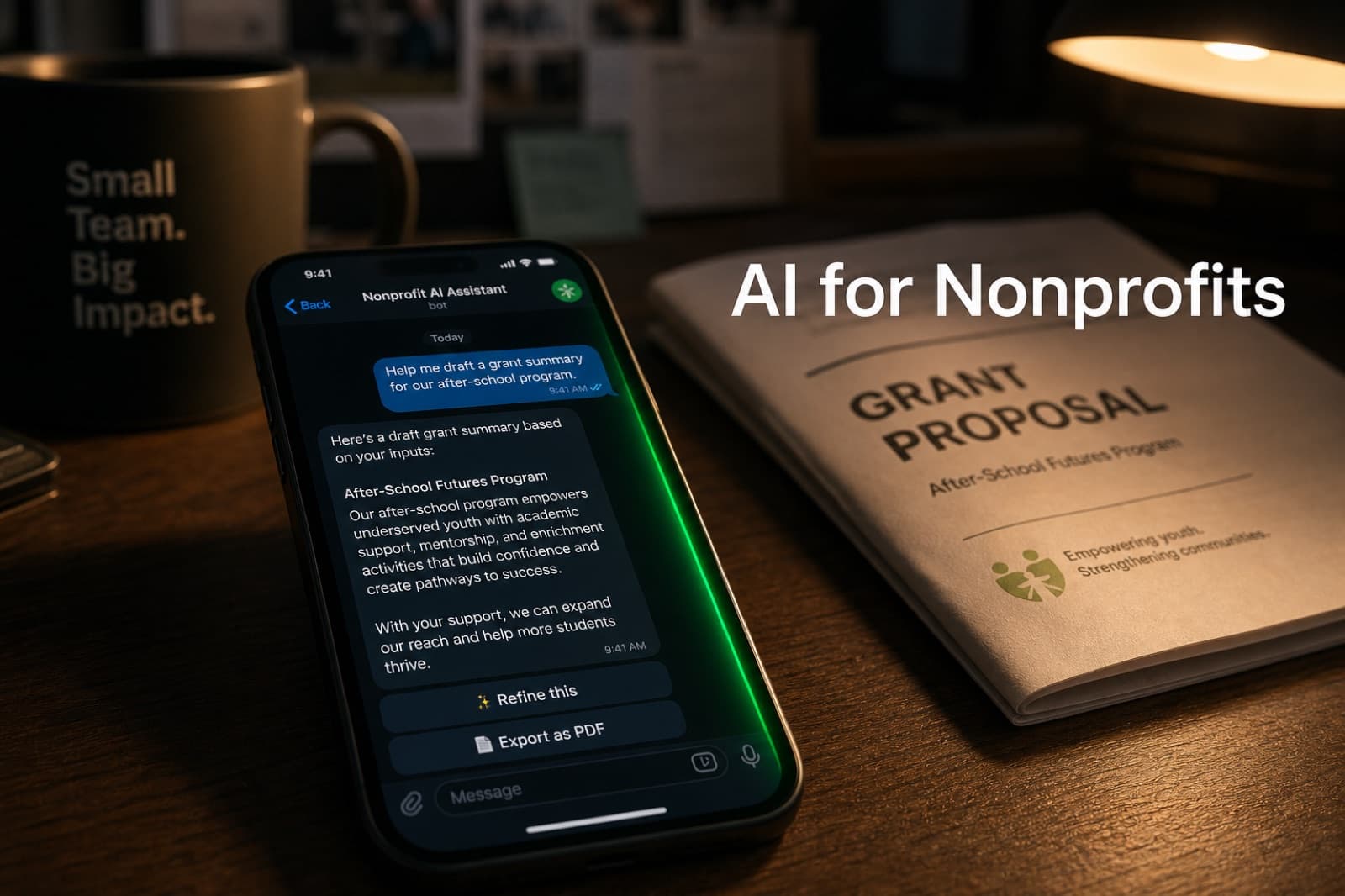
You Are Not the Buyer Most "AI for Nonprofits" Posts Are Written For
If you run a small or mid-size nonprofit in 2026, the listicles ranking the best AI tools for your sector are not really written for you. The "top 10 AI agents for nonprofits" articles overwhelmingly point at Salesforce Nonprofit Cloud with Agentforce ($125-$650 per user per month, plus $10k-$50k in professional services for a real deployment), Aisera's enterprise agentic AI suite, Virtuous Momentum and Insights, and a handful of $200-plus platforms whose case studies all feature household-name charities with a dedicated tech team.
Those are real products. They are also, mostly, built for organizations with a $20M-plus operating budget, an in-house Salesforce admin, and a board that signs off on six-figure annual platform spend. If your budget is $1M to $5M, if your "tech team" is the development director who happens to be the one who once set up Mailchimp, this guide is for you.
Where Your Time Actually Leaks
The headline numbers on nonprofit AI adoption are worth knowing. The 2026 reporting puts AI usage at 92 percent of nonprofits in some form, though most of that is isolated tools (a ChatGPT subscription for the comms manager, Grammarly for the grant writer) rather than anything integrated into how the org works. The State of AI in Nonprofits research has found that around 60 percent of nonprofit professionals say they would use AI for grant writing if they had a tool they trusted, and 24.6 percent are already doing it informally.
The reason the appetite is so high is the workload math. Small nonprofits invest up to 200 hours into a single federal grant application, with success rates in the 10 to 15 percent range. Program staff at most nonprofits spend a material share of their time on documentation, donor reporting, compliance forms, and CRM hygiene that is adjacent to but not the same as serving the people the org exists to serve. One healthcare nonprofit running an AI layer through its admin work estimates it has eliminated six to eight hours a day of manual tasks across the team.
The honest read of those numbers is that for a small-to-mid-size nonprofit, the highest-return AI is not a $50k enterprise AI platform. It is a much smaller, much cheaper layer that absorbs the unglamorous administrative weight your staff is currently giving an evening a week to.
What the "AI Agent" Market Actually Looks Like at Your End
The phrase "AI agent" gets used loosely. For a small-to-mid-size nonprofit it is worth separating the categories.
Enterprise AI suites bolted onto your CRM. Salesforce Agentforce, Microsoft Copilot for Nonprofit, Aisera Agentic AI. These plug into Nonprofit Cloud or Dynamics, run analytics on your donor database, generate forecasts, draft outreach. Pricing typically lands between $125 and $650 per user per month, plus implementation, plus the underlying CRM seat cost. Powerful if you already live in Salesforce and have a dedicated admin. Wildly overkill if your CRM is a Google Sheet and a Mailchimp list.
Specialized grant-writing assistants. Grantable, FundRobin, Grant Assistant, and a growing tier of "AI grant writer" SaaS products. Typically $30 to $200 per month, with credit-based ceilings. Genuinely useful for the first draft of a federal LOI, but limited to the grant-writing slice of your week and increasingly competing with the same general-purpose models you can use directly.
Donor-engagement AI built into fundraising platforms. Virtuous Momentum and Insights, Bonterra AI features, Bloomerang's AI scoring. Useful if you already pay for the platform; usually not enough on their own to justify switching.
General-purpose AI assistants with no nonprofit context. ChatGPT Plus, Claude Pro, Gemini Advanced. Twenty dollars a month, no memory of your org between sessions, no integration with your messaging or your CRM, but the underlying model your specialist tools are quietly calling anyway.
A personal agent for your team that lives on the messaging app they already use. The category that is barely served and usually the one that would save you the most hours. It captures the voice note your program officer records between two site visits, drafts the donor thank-you in your org's voice, chases the slow grant officer at the foundation that has been sitting on your LOI for six weeks, and remembers the context of every donor and every grant across conversations. It lives where your team already is, normally a Telegram chat on their phone.
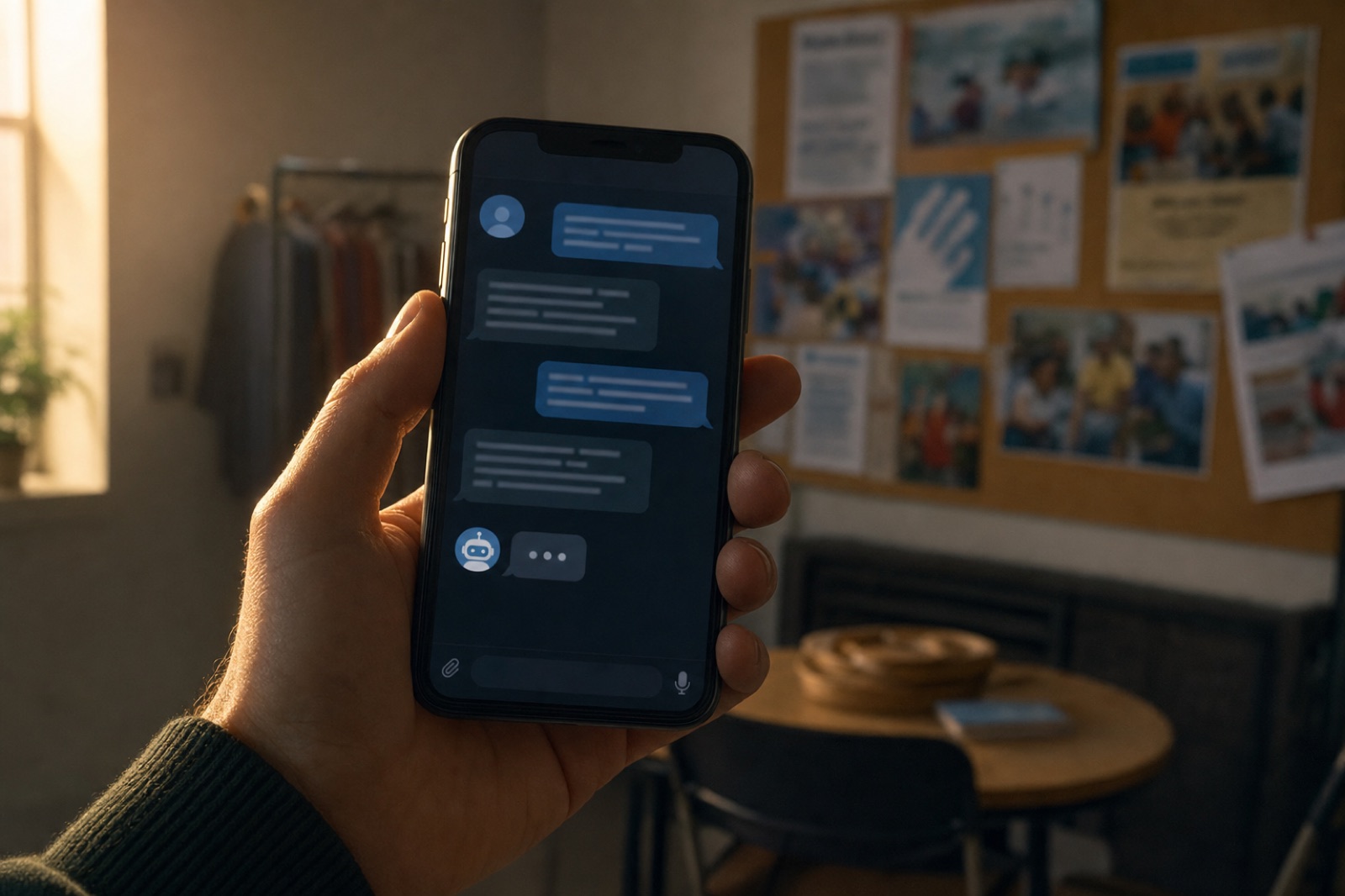
The first four categories are crowded markets, well-served, and easy to evaluate by Googling. The fifth, your team's personal-ops layer, is where most of a small nonprofit's staff time leaks, and it is the layer the listicles barely cover because there is no $300-a-month enterprise SaaS to recommend.
What to Actually Evaluate Before You Pay for Anything
If you are looking at any AI for a small-to-mid-size nonprofit in 2026, the questions worth asking are unglamorous.
Does it remember your org between conversations? A lot of "AI for nonprofits" is a chat window with no memory. You re-explain who your major donors are, which grant cycles you are inside of, which programs are running this quarter every time. For a personal agent, persistent memory across sessions is the feature that turns it from a fancy autocomplete into something that earns its keep. Our breakdown of persistent memory and skills walks through how the runtime model works.
Where does donor and beneficiary data live, and who can see it? Donor giving history, beneficiary case notes, and grant-application drafts are sensitive even by sector standards. Some categories of nonprofit (domestic-violence shelters, refugee orgs, harm-reduction services) have a duty of care that makes "we send all this to a third-party SaaS" a non-starter. Whatever you pick, you should be able to give a concrete answer to your board about where the data sits, not a vague one.
Can you bring your own model and your own keys? BYOK (bring-your-own-key) is the difference between paying $300 a month for a SaaS that resells someone else's model and paying for the actual tokens your staff consume, which for a typical small-nonprofit workload is a few dollars a month. Our OpenRouter setup guide shows what BYOK looks like in practice.
Where does it run? Hosted enterprise SaaS is convenient and expensive. A self-hosted runtime on a $5 VPS, or a managed runtime where you keep your own keys, is more private, removes vendor lock-in, and survives the next pricing change. The trade-off is one evening of setup against ongoing flexibility. For an always-on agent hooked into your team's phones, self-hosted or owner-controlled hosting is increasingly the practical default. Our breakdown of self-hosted versus managed pricing has the real numbers.
Does it cover the parts of the week the listicles ignore? The best return for a small nonprofit is rarely a $30k AI-powered donor-scoring overlay. It is the agent that catches the voice memo your program officer dictates in the field, drafts the donor follow-up that has been on the development director's to-do list for three weeks, chases the foundation program officer that is 14 days late on a response, and pings the volunteer coordinator about the orientation roster they have not finalized yet.
The Stack Math, Honestly
Here is what the price ladder actually looks like for a small-to-mid-size nonprofit shopping for AI in 2026.
| Tool | Audience | Approximate Price | What It Does |
|---|---|---|---|
| Salesforce Agentforce, Microsoft Copilot for Nonprofit, Aisera | Orgs with a Salesforce or Dynamics admin and a 7-figure platform budget | $125-$650 per user per month plus $10k-$50k services | Enterprise AI bolted onto Nonprofit Cloud / Dynamics |
| Virtuous Momentum, Bonterra AI, Bloomerang AI scoring | Orgs already on a paid fundraising platform | Add-on to existing $200-$1500 per month platform | Donor scoring, retention prediction, generated outreach |
| Grantable, FundRobin, Grant Assistant | Development teams writing federal or large foundation grants | $30-$200 per month | First-draft LOIs, narrative scaffolds, compliance checks |
| ChatGPT Plus, Claude Pro, Gemini Advanced | Anyone | $20 per month per seat | General-purpose chat, no nonprofit context, no memory |
| Self-hosted personal agent on a $5 VPS | Privacy-sensitive small-to-mid-size orgs with one technical staff member | ~$5 VPS plus a few dollars in API usage | Personal agent on staff messaging apps, BYOK, persistent memory |
| Managed personal agent (Hermify Starter) | Orgs that do not want to manage a VPS | $19 per month BYOK | Same agent, no infrastructure |
A complete personal-ops AI layer for a small nonprofit in 2026 typically lands between $25 and $100 per month total, not the $5k-plus annual figure the enterprise listicles imply. The orgs that report actually saving 6 to 10 hours a week per staff member are not the ones that bought the most expensive platform. They are the ones whose personal-agent layer feeds the rest of the stack instead of competing with eight browser tabs.
Where a Personal Agent Like Hermes Fits
Hermes Agent is an MIT-licensed runtime built for exactly the fifth category above. Your org self-hosts it on a $5 VPS, or you let Hermify host it for $19 to $49 a month per agent, you connect it to your own model provider with your own API key (so donor and beneficiary data flows through your account, not someone else's), and your staff talk to it through Telegram, Signal, Slack, or email, whichever app is already on their phones. It keeps a persistent memory of your org across conversations, so when your development director says "draft the thank-you for the gift that came in this morning," it knows which donor, which campaign, which last-touch date, and what tone you used last time.
For a small-to-mid-size nonprofit the practical shape looks like this:
- Donor follow-ups. A major-gift donor commits over the phone on Monday. Your development director records a 60-second voice note in Telegram. The agent transcribes, drafts the thank-you in your org's voice with the campaign-specific language, and stages it for the director to send.
- Grant cycle tracking. A foundation program officer is 14 days late on a response to your LOI. The agent surfaces it, drafts a polite nudge, and reminds the development team. The same loop catches the report deadline that snuck up on you.
- Field staff voice notes. Your program officer is between two site visits and dictates a 90-second update. The agent transcribes, parses the action items, files the case notes against the right beneficiary record, and queues anything urgent for the program director.
- Volunteer coordination. New volunteer signed up at the weekend event. The agent drafts the onboarding email, schedules the orientation reminder, and pings the volunteer coordinator if the slot fills up. Multi-platform support means the same agent can talk to volunteers on WhatsApp and your staff on Telegram.
- Weekly board digest. Every Friday at 4pm the agent sends the executive director a short message with the week's gifts, the grants in flight, and any anomalies in program expenses. No CRM dashboard to open.
The cost profile is different from the listicle tools. A $5 VPS plus a few dollars in model API usage is a normal monthly bill. The trade-off is that you spend an evening with the docs to set it up, instead of clicking through a Salesforce procurement process. For orgs that do not want the VPS step, Hermify's hosted Starter tier gives you the same agent BYOK at $19 a month per agent, and your data and your API keys stay yours.
A Sensible Starting Stack for a Small-to-Mid-Size Nonprofit
You do not have to pick one tool and call it your "AI strategy." A workable 2026 stack for a $1M-$5M-budget nonprofit often looks like this:
- Your existing CRM, whatever it is. Do not switch to Salesforce just for the AI.
- A model provider with BYOK. A paid OpenAI, Anthropic, or OpenRouter account so the tools below call a real model on your terms.
- A personal agent layer on staff phones for donor follow-ups, grant tracking, voice-to-task on field work, and the weekly board digest. This is the layer most small nonprofits are missing and the one with the largest hour-savings return.
- A grant-writing assistant only if grants are how you grow. Skip it if foundation and individual giving cover you.
- A general-purpose ChatGPT or Claude seat for the comms manager and the executive director for the long-form drafting work the personal agent does not touch.
Start with the layer that costs you the most hours. For most small nonprofits that is not donor scoring and not a $50k Salesforce add-on. It is the personal-ops layer that absorbs the documentation, the follow-ups, the chasing, and the digest work that is currently eating evenings. The parallel use-case for for-profit owner-operators (where we walk through the same exercise for a $1M revenue business) is covered in our post on the AI agent for small business owners. Get started with Hermify if you want to try a personal agent on your team's phones before paying for a feature set built for an org ten times your size.
What This Does Not Solve
An AI agent does not write your major-gift solicitation, does not make the call about whether to take the controversial grant, and does not replace the trust your development director has built with your top 20 donors over a decade. It does not stop you from working evenings if your real problem is that the org needs another full-time staff member, not a tool.
What it does do is buy your team back a few hours a week each by absorbing the surrounding administrative weight. For a lot of small-to-mid-size nonprofits, that is the difference between a development director who is burning out and one who actually has time to be in the room with the donors who matter. It is a meaningful difference, and it is available at a fraction of the price the enterprise listicles imply.
Sources
- AI for Nonprofits in 2026: 7 Best Tools and Practical Guidance - Virtuous
- The best AI grant writing tools for nonprofits in 2026 - Grant Assistant
- Artificial Intelligence for Nonprofits: A Complete 2026 Guide - LiveImpact
- 7 Best AI Grant Writing Tools for Nonprofits in 2026 - FundRobin
- 9 Best AI Assistants for Nonprofits in 2026 - Carly
- The Impact of AI on Nonprofits in 2026 - UST
- AI for Nonprofits: Where Automation Actually Makes a Difference - Wiss
- Salesforce.org Nonprofit Cloud Pricing 2026 - PricingNow
- How Much Does Salesforce Einstein Agent Cost - Monetizely
- WhatsApp for NGOs and Non-Profits 2026 Guide - AiSensy
Run Your Own Hermes Agent
Bring your API key, connect Telegram, and get a self-improving AI agent live in 60 seconds.
Get Started