AI Agent for Sales Reps: A Practical Guide for 2026
Individual reps do not need a $250-a-month autonomous SDR. Here is what an AI agent actually does for a rep on a small team in 2026.
The Real Problem on a Sales Rep's Calendar Is Not the Cold Outbound
If you sell for a living in 2026, the noise around AI sales agents probably does not match your week. Salesforce is pitching Agentforce as the always-on Atlas-Reasoning SDR for enterprise pipelines. Artisan starts Ava at $250 a month and climbs to $600 for the Employee tier. 11x.ai, Relevance AI, and Apollo all want to sell your manager a fully autonomous outbound machine. Meanwhile, you are an individual rep on a team of three, six, or fifteen, and your bottleneck is not "we need an autonomous SDR." It is the recap you did not write up after the discovery call, the proposal sitting in drafts for nine days, the follow-up to the warm lead you forgot from Monday, and the deal context you keep losing every time you switch accounts.
This post is for working reps who want a practical answer, not a sales pitch. We will walk through what an "AI agent" actually means for an individual rep on a small team, what the market looks like at that end of the price ladder, what to evaluate before you buy anything, and how a self-hosted personal agent reachable from your phone compares with the platforms aimed at sales orgs ten times your size.
What an AI Agent Means for an Individual Rep
The phrase "AI agent for sales" gets used loosely. For an individual rep it helps to separate three things that all sit under the same umbrella.
An autonomous AI SDR runs the top of the funnel end-to-end: research, sequence building, outbound emails, reply handling, meeting booking. Artisan Ava, 11x, Regie, and the SDR side of Salesforce Agentforce live here. The Atlas-Reasoning engine inside Agentforce handles lead qualification, objection handling, and 24/7 prospect engagement at enterprise scale. These tools are real, they work for a specific shape of org, and they are designed for sales teams whose top-of-funnel volume justifies the seat price.
A sales-team SaaS agent layer sits one tier down: Lindy, Amplemarket Duo, Apollo's AI, and the agentic tools coming out of HubSpot and Pipedrive. These usually sell per seat to a team, plug into your CRM, and automate sequences plus follow-ups with the rep in the loop. Pricing here lands in the $50 to $200 per user per month range depending on the seat and the integrations.
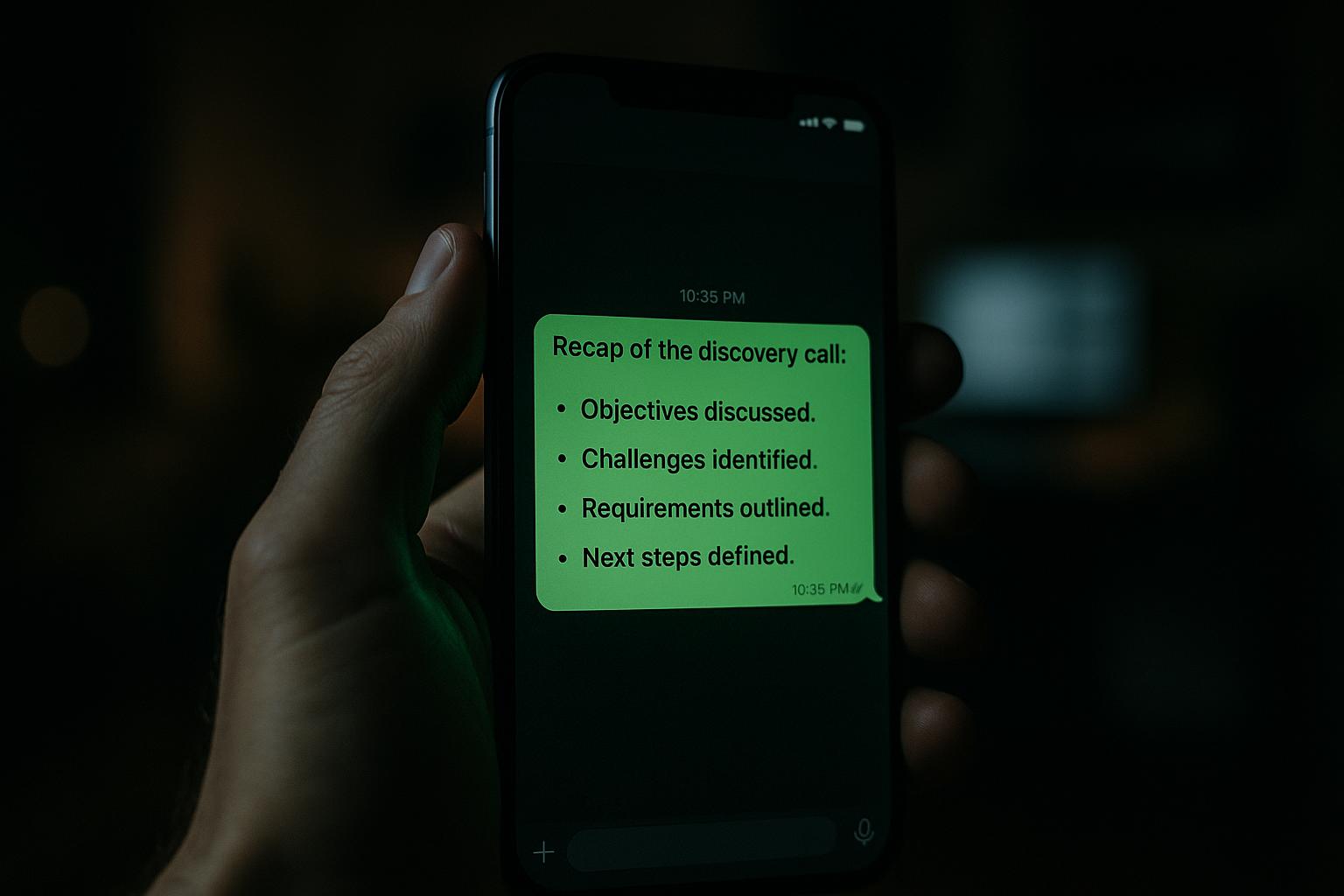
A personal agent is the one most individual reps actually need, and the one hardest to find packaged in the right shape. It captures the voice memo you record between meetings, drafts the follow-up in your voice, remembers that the VP of Engineering at Acme cares about latency and the CFO cares about per-seat cost, pings you when a warm lead has gone 11 days quiet, and lives on your phone in the same chat app where everything else already lives. It does not replace your CRM and it does not replace your team's sequence tool. It absorbs the surrounding admin layer that pulls the energy out of selling.
The first two categories have crowded markets aimed at sales managers and RevOps. The third is where most of an individual rep's time leaks, and it is the gap between a $20 per month ChatGPT Plus seat and a $250 to $600 per month autonomous SDR seat that most working reps fall into.
The Market in 2026, Honestly
Before you pick anything, it is worth knowing what the price ladder actually looks like for an individual rep.
| Tool | Audience | Approximate Price | What It Does |
|---|---|---|---|
| Salesforce Agentforce SDR | Enterprise sales orgs on Sales Cloud | Custom enterprise pricing, multi-thousand per month | Autonomous SDR inside Salesforce, 24/7 prospect engagement |
| Artisan Ava | Outbound-heavy teams | $250 to $600 per month per seat | Autonomous outbound SDR, sequence + reply handling |
| 11x.ai, Regie.ai | Outbound-heavy teams | $400+ per month per seat | Autonomous SDR with research and personalization |
| Apollo, Amplemarket, Lindy | Reps and small teams using a sequencer | $50 to $200 per user per month | AI-assisted sequences, reply triage, meeting booking |
| Gong, Fathom, Fireflies | Anyone with calls | $0 to $40 per user per month | Call transcription, deal coaching, action items |
| Claude Pro, ChatGPT Plus | Anyone | $20 per month | General-purpose chat, no persistent deal context |
| Self-hosted runtime on a $5 VPS | Privacy-aware reps wanting per-account memory | ~$5 VPS + a few dollars in API usage | Personal agent on your messaging app, BYOK, persistent memory |
Two patterns stand out. First, by early 2026 the autonomous-SDR-replaces-the-rep narrative has cooled significantly. The teams that fully replaced human SDRs with Artisan, 11x, or similar tools in 2024 to 2025 have largely reverted to hybrid models, where the agent does the volume work and a human handles the relationship-building. Second, the tools that solve the personal-agent layer best for an individual rep are almost never the ones marketed as "AI for sales." The big "AI SDR" brands target teams with serious outbound volume, not the rep working a list of 80 named accounts.
What to Actually Look For
If you are evaluating any AI for your own use as a rep in 2026, the questions worth asking are the unglamorous ones.
Does it remember anything between conversations? A lot of "AI for sales" is a chat window with no memory. You re-paste the account context every time. For a personal agent that handles your pipeline, persistent memory across sessions is the feature that turns it from a fancy autocomplete into something useful. Per-account context (stakeholders, prior conversations, pain points, current open loops) is where the compounding value lives. We dig into this pattern in our post on persistent memory in an AI assistant.
Where does the data live, and who can see it? Account information, deal stage notes, and pricing conversations are sensitive even when they are not formally regulated. Some prospects ask the procurement question explicitly, especially in financial services, healthcare, and public-sector accounts. Whatever you pick, you need to be able to answer the data-flow question concretely when your sales engineer or your customer asks. Self-hosting on a $5 VPS is one of the cleanest answers to that question.
Can you bring your own model and your own keys? BYOK is the difference between paying a flat $50 to $200 per seat per month and paying for the actual tokens your usage consumes, plus the freedom to switch providers when one of them changes terms. For an individual rep the model API costs are typically a few dollars a month, well under any branded SaaS price.
Where does it run? A hosted SaaS is convenient. A self-hosted runtime on a $5 VPS or your own machine is more private, removes vendor lock-in, and survives the next pricing change. For the kind of always-on agent you want hooked into your phone, self-hosted is increasingly the practical default for an individual rep who does not want yet another corporate tool in the stack. Our post on the pricing math behind self-hosted vs managed Hermes Agent walks through the actual numbers.
Does it do anything outside the sequence? The best return on time for an individual rep is rarely a faster cold email. It is the agent that captures your post-call voice notes, drafts the next nudge to the quiet deal, schedules the quarterly check-in with the existing customer, and flags the account that has gone cold. None of the autonomous-SDR platforms cover that surface end to end for a single rep working warm pipeline.
Where a Self-Hosted Personal Agent Fits
Hermify is one option for the third category, the personal-agent piece. It is an MIT-licensed runtime you self-host, you connect to your own model provider with your own API key (OpenAI, Anthropic, OpenRouter, or others), and you talk to it through Telegram, Signal, WhatsApp, Slack, or email - whichever messaging app already lives on your phone. It keeps a persistent memory across conversations, so when you say "draft a follow-up to the VP of Engineering at the deal we demoed Tuesday," it knows which deal, which stakeholder, and which thread you left hanging. The broader pattern is covered in our post on persistent memory and skills in an AI assistant.
For an individual rep the practical shape looks like this:
- Post-call capture and follow-up. You walk out of a discovery call, send a 90-second voice note. The agent transcribes it, drafts the recap email with action items, and saves the call notes to that account's memory.
- Pipeline cadence. A warm lead has gone 11 days quiet. The agent surfaces it on Monday morning, drafts the next nudge in your voice, you hit send. The unsexy follow-up loop that decides who hits quota and who does not.
- Stakeholder map. You mention the new VP of Operations at an existing customer. The agent updates the stakeholder map for that account, notes the reporting line, and flags that they were not in the original buying committee.
- Deal context. You ask "what did we promise the CFO at Acme in the security review?" The agent retrieves the answer from the per-account memory instead of forcing you to scroll through Slack and notes.
- Sequence work stays where it is. For volume outbound and CRM logging you keep using Outreach, Salesloft, Apollo, or whichever tool your team standardized on. A personal agent is not a replacement for your team's sequencer; it is the layer that wraps your day around it.

The cost profile is also different from the autonomous SDR platforms. A $5 VPS plus a few dollars a month in model API usage is a normal monthly bill for a single-rep setup. The trade-off is that you spend an evening with the docs to set it up, instead of clicking "Subscribe." For reps who handle named accounts under strict confidentiality expectations, who work multi-region pipelines with mixed data-residency rules, or who simply do not want another SaaS sitting between them and their account notes, that trade-off is usually worth it. For reps who want zero setup and are happy with a managed hosted runtime, Hermify's hosted tier gives you the same agent without the VPS step.
A Workable Stack for an Individual Rep
You do not have to pick one tool and call it your "AI strategy." A practical 2026 stack for an individual rep on a small team often looks like this:
- A call layer. Gong, Fathom, or Fireflies for call recording, summary, and action items. Free or low-cost tiers usually cover a single rep's volume.
- A model provider with BYOK. A paid OpenAI, Anthropic, or OpenRouter account so the personal-agent layer can call a real model with your terms, not a SaaS reseller's.
- A personal agent layer that lives on your phone, captures your day, drafts your follow-ups, and remembers your accounts across sessions. This is where a self-hosted runtime like Hermify fits.
- A sequencer when you have outbound volume. Outreach, Salesloft, Apollo, or whatever your team uses. The personal agent does not replace it, it sits next to it.
- The CRM you already use. Salesforce, HubSpot, Pipedrive. The personal agent reads from it and drafts updates against it, but the CRM remains the source of truth your manager looks at.
You do not need to decide everything at once. Start with the layer that costs you the most time. For most individual reps that is the personal-agent layer, because the call-recording market is well-served, the sequencer market is well-served, and the layer that captures your day and remembers your accounts is the one nobody is selling at your end of the price ladder. If the personal-agent layer sounds like the missing piece for you, see also our umbrella guide for owner-operators of small businesses or the AI agent for consultants guide, both of which cover variations on the same pattern.
Get started with Hermify if a personal agent on your phone is the layer you want to try first - you keep your data, you keep your model choice, and you keep the agent that remembers your accounts across the year.
What This Does Not Solve
An AI agent does not run the discovery call for you, does not replace your judgment in the negotiation, and does not eliminate the need to actually understand the buyer. The 2024 to 2025 wave of "autonomous SDR replaces the rep" largely did not survive contact with reality: by early 2026 most sales orgs that tried full replacement have returned to hybrid models with humans owning relationships and agents owning volume. Use any agent the same way you would use a competent SDR or BDR: useful, fast, and double-checked before it sends.
It also does not replace the relationships that close deals and retain customers. The five touches it takes to convert a referral, the 45-minute call where a worried buyer needs to be heard before they need an answer, the renewal dinner that decides next year's number - none of that is automatable in 2026, and probably will not be for a long time. What an AI agent does is buy you the time to do those things, by absorbing the surrounding administrative weight that makes selling exhausting.
Sources
- 9 Best AI Agents for Sales in 2026: Features and Comparisons - Lindy
- Best AI Agents for Sales Teams in 2026 That Actually Close Deals - Carly
- Best AI Agents for Sales Tool Comparison 2026 - Workist
- Best AI Sales Agent: Agentforce Sales - Salesforce
- Boost Your Sales with Ava, the Ultimate AI Sales Agent - Artisan
- 8 Best AI Sales Agents and AI SDR Tools in 2026, Compared - Amplemarket
- 15 Best AI Sales Agents for Boosting Revenue in 2026 - monday.com
- 10 AI Agents Every Sales Team Needs in 2026 - MindStudio
Run Your Own Hermes Agent
Bring your API key, connect Telegram, and get a self-improving AI agent live in 60 seconds.
Get Started