AI Assistant for Property Management: A 2026 Field Guide
79% of tenants want to text their property manager. Here is what an AI assistant actually does for a working property manager in 2026, and what to look for.
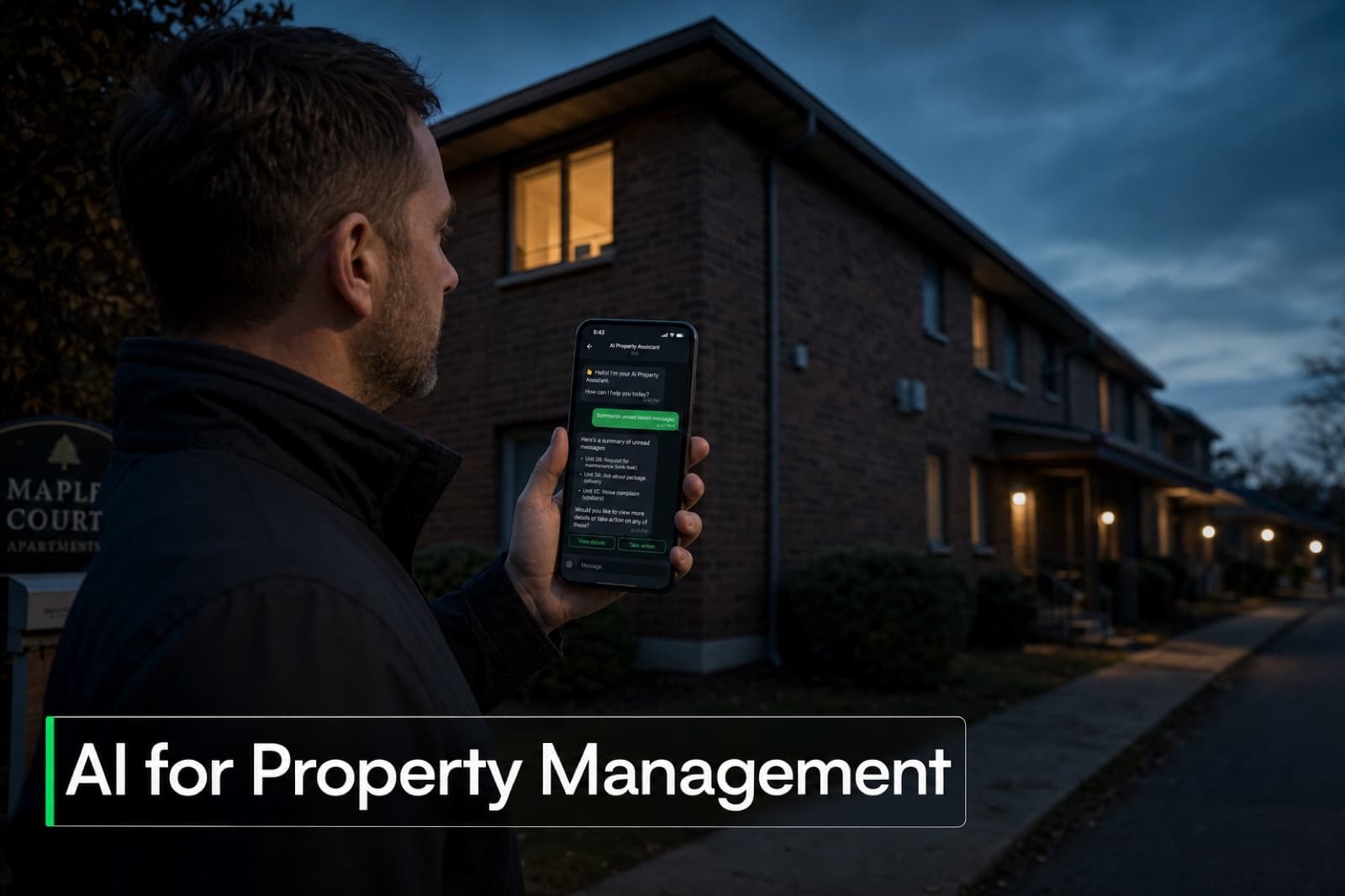
The Inbox That Never Closes
A single working property manager carrying 30 doors spends, on average, about 4 hours per month per rental on day-to-day operations. That is 120 hours a year, and the largest single slice is communication: late-night maintenance texts, lease questions, payment reminders, vendor coordination, and the same five tenant questions answered in fifteen different ways. Over 79 percent of tenants now say they want to text their property management company instead of calling, and text messages get a 98 percent open rate within five minutes. The inbox does not close at 6pm. It does not close on Sunday. It does not close when you take your kid to the doctor.
That is the problem an AI assistant is supposed to solve. The question in 2026 is which kind of AI assistant, because the phrase covers four very different products, only one of which actually shows up where a working property manager spends the day.
This guide is for the owner-operator carrying 5 to 200 doors who is not ready to swap their entire stack for an enterprise platform, but who is also tired of being woken up at 1am because someone smelled gas. We will walk through what an AI assistant actually means for a working property manager in 2026, what the market looks like, the five questions to ask before you buy anything, and where a personal agent on Telegram fits next to the big property-management AI brands.
What "AI Assistant" Means in Property Management Right Now
The phrase "AI assistant for property management" covers four very different products in 2026. It is worth naming them before you compare prices.
Tenant-facing AI receptionists answer the phone and the chat widget. Stan AI, EliseAI, Super, and the voice layer inside MagicDoor sit here. They take the inbound leasing call at 11pm, qualify the lead, hand off the maintenance request, and route the rent-payment question to a self-service portal. The promise is that 60 to 80 percent of routine inbound questions get resolved without a human touching them. Pricing is usually per-unit per-month, somewhere between $2 and $8 per door at the small-portfolio tier.
Embedded AI inside the PMS. Buildium's Lumina, AppFolio's Realm-X, and similar features inside Yardi, Rentec Direct, and DoorLoop are AI capabilities bolted onto an existing property-management platform. They draft tenant communications, summarize maintenance threads, score applications, and write listing descriptions inside the dashboard you already pay for. You do not pick the model, and the AI lives where the rest of your PMS lives, on a desktop, not in your pocket.
Maintenance and vendor coordination AI. Conduit, GrowthFactor, and the maintenance modules inside MagicDoor and EliseAI specialize in triaging tenant maintenance requests, creating work orders, and dispatching vendors. A message like "my upstairs neighbor's washing machine is leaking into my bathroom" becomes the right category, the right urgency, and the right vendor without a coordinator parsing the language by hand.
A personal agent. This is the fourth category and the one that is hardest to find off the shelf in the right shape. It is the AI that lives on Telegram or WhatsApp on your phone, captures your post-walkthrough voice note, drafts the follow-up to the tenant whose lease is up in 60 days, remembers which unit at Cedar Lane has the temperamental water heater, and pings you when the property-tax payment is two weeks out. It does not replace your PMS. It wraps your day around it.
Most owner-operators end up paying for one of the first three categories and feel like AI is "working" without ever touching the fourth. The first three categories sit on a dashboard you check twice a day. The personal-agent layer is the one that follows you between properties.
The Market in 2026, Honestly
Before you pick anything, it helps to see what the price ladder actually looks like for a working property manager.
| Tool | Audience | Approximate Price | What It Does |
|---|---|---|---|
| AppFolio Realm-X | Mid-market to enterprise PMs | Custom enterprise pricing | Full PMS with embedded AI for leasing, accounting, communications |
| Buildium with Lumina AI | Small to mid-market PMs | $58 to $400+ per month + unit fees | PMS with AI for communications, maintenance, accounting |
| EliseAI | Multifamily, larger portfolios | Custom enterprise pricing | Conversational AI receptionist for leasing and maintenance |
| MagicDoor | Independent PMs and landlords | $0 to $5 per unit per month | All-in-one PMS with AI messaging, translations, suggestions |
| Stan AI | HOAs and small property managers | $99 to $499+ per month | AI phone and chat for resident questions |
| Super (hiresuper.com) | Small to mid-market PMs | $99 to $499+ per month | AI receptionist across phone, email, text |
| ChatGPT Plus, Claude Pro | Anyone | $20 per month | General chat, no PM context, no persistent memory |
| Self-hosted personal agent | Privacy-conscious owner-operators | ~$5 VPS + a few dollars in API usage | Personal agent on Telegram, BYOK, persistent memory |
Two patterns stand out. First, a complete AI stack for a small-portfolio property manager in 2026 lands somewhere between $100 and $600 per month if you buy off-the-shelf, more if you also use a team-grade PMS with the AI add-ons turned on. Second, almost every product marketed under the loudest "AI for property management" headlines is built for portfolios of 200 doors and up. A 20-door owner-operator is often paying for capacity they do not need and capability they never use.
What to Actually Look For
If you are evaluating any AI assistant for property management in 2026, the questions worth asking are the unglamorous ones.
Where does the tenant data live, and who can see it? Tenant information is regulated under your state's landlord-tenant statutes, fair-housing rules, and sometimes broader privacy frameworks like CCPA. Every model API provider publishes data-use terms; the serious ones offer enterprise tiers that exclude your prompts from training. Whatever you pick, you need to be able to answer the data-handling question concretely when a careful tenant or your insurance carrier asks. "I am not sure" is not the right answer for someone holding the keys to your tenants' homes.
Does it remember anything between conversations? A lot of AI is a chat window with no memory. You re-paste the unit details, the tenant history, and the maintenance log every time you ask a question. For a personal agent that handles your day, persistent memory across sessions is the feature that turns it from a fancy autocomplete into something useful. Per-property and per-tenant context (lease end date, pet on file, the water heater you replaced in May, the neighbor noise complaint last fall) is where the compounding value lives.
Can you bring your own model and your own API keys? BYOK is the difference between paying $99 per month flat and paying for the actual tokens your usage consumes, plus the freedom to switch providers when one of them changes terms. For a one-person operation the API costs are usually a few dollars a month. Our guide to the best model providers for a personal agent walks through what BYOK looks like in practice.
Where does it live during your day? A web dashboard is convenient but you do not open it between showings or vendor calls. Email is fine for end-of-day work but it is not where you actually talk. The property managers who report the most value from AI in 2026 are the ones whose assistant is reachable from the messaging app already on their phone, usually Telegram or WhatsApp.
Does it do anything outside the dashboard? The best return on time for an owner-operator is rarely a faster listing description. It is the agent that captures your post-walkthrough voice note, drafts the next nudge to a tenant whose rent is three days late, schedules the 60-day-out lease-renewal conversation, and flags the vendor invoice that has been sitting for two weeks. None of the receptionist, PMS, or maintenance-only tools cover that surface end to end for an individual operator.
Where a Self-Hosted Personal Agent Fits
Hermes Agent is one option for the fourth category, the personal-agent piece. It is an MIT-licensed runtime you self-host or run on the managed Hermify hosting tier. You connect it to your own model provider with your own API key (OpenAI, Anthropic, OpenRouter, or others), and you talk to it through Telegram, the messaging app already on your phone. It keeps persistent memory across conversations, so when you say "send Unit 4B at Cedar Lane the lease-renewal email," it knows which unit, which tenant, which lease end date, and which renewal terms you offered last cycle. The broader concept is covered in our post on persistent memory and skills in an AI assistant.
For a working property manager the practical shape looks like this:
- Post-walkthrough capture. You finish a unit walkthrough, sit in the car, send a 90-second voice note. The agent transcribes it, files the condition report against that unit, drafts the move-out deposit summary, and saves the engagement notes to that tenant's memory.
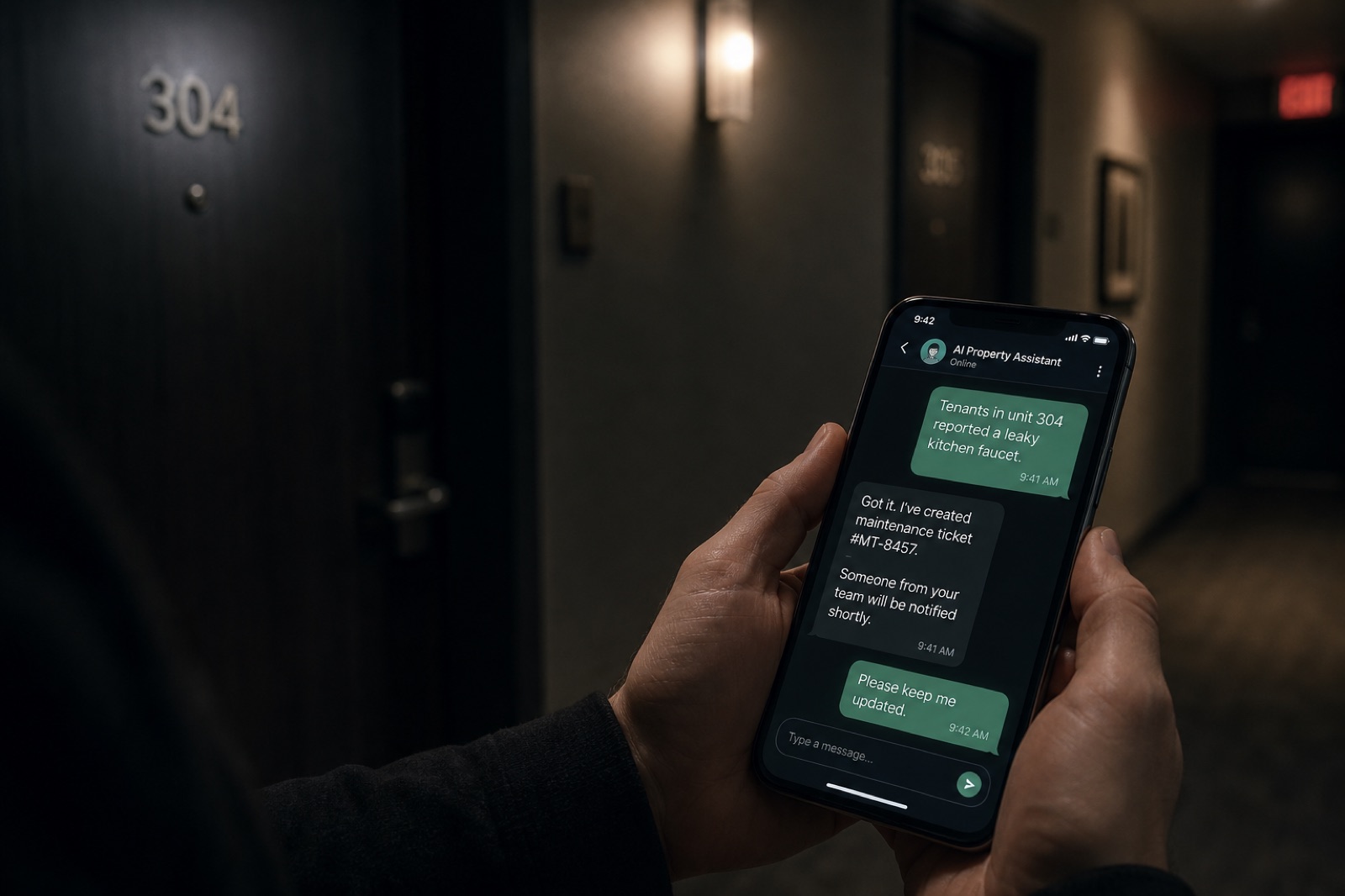
- Maintenance triage that does not slip. A tenant texts you about a leak at 11pm. The agent acknowledges, gathers the photos and location, drafts the work order, suggests the vendor you used last time, and pings you only if the urgency is high.
- Per-property memory. Lease end date, pet on file, last rent increase, the appliances you replaced last year, the vendor each unit prefers. Surfaced when you ask, not buried in a spreadsheet.
- Cadence and reminders. Lease renewal 60 days out, annual inspection, property-tax deadlines, insurance renewal. The agent runs the calendar around your real schedule and pings you when one of them is about to slip.
- Deliverable work stays where it is. Rent collection, accounting, the lease itself, eviction filings - your PMS owns those. A personal agent is not a substitute for your PMS, your accounting software, or your legal docs. It is the layer that wraps your day around them.
The setup is cheap. A small VPS runs about $5 per month, plus a few dollars in model API usage if you BYOK. Total monthly cost for an owner-operator typically lands between $10 and $20. The managed Hermify tier removes the VPS step entirely if you would rather not run your own server. Either way the agent is yours, the model keys are yours, and the tenant data is on infrastructure you control.

When AI Is Not the Answer
It is worth being honest about where AI does not help an owner-operator.
If you have one or two doors, the time savings probably do not justify the setup cost or the monthly fee for anything other than ChatGPT Plus, and even that is overkill for most months. If your tenant communication volume is genuinely under 10 messages a week, the math does not pencil. AI gets useful around the 5-to-10-door range and starts paying back its setup time noticeably from 10 to 20 doors.
If your PMS already covers the basics well and your tenants are quiet, do not bolt on an AI receptionist just because the trade press says you should. The leverage is in the friction you actually feel, not the friction someone is selling you.
If you are in a heavily regulated rent-controlled jurisdiction, you cannot let an AI agent send tenant notices unsupervised. Notice templates, rent-increase letters, and termination paperwork all need a human reviewer in the loop. A personal agent is fine for drafts. It is not fine for sending the final document on your behalf without a check.
A Practical Setup for an Owner-Operator
If you decide to try the personal-agent path, the rough setup is:
- Pick the messaging surface. Almost always Telegram - it has groups, voice notes, file uploads, and a bot API that AI agents can plug into without months of platform-review hoops. WhatsApp is technically possible but the Business API approval process is heavier.
- Pick a model provider. Most owner-operators land on OpenAI or Anthropic for quality, or OpenRouter for routing across multiple providers behind one key. The model provider guide covers the trade-offs.
- Pick managed vs self-hosted. Managed Hermify takes care of the server, updates, and backups. Self-hosting on a $5 VPS gives you full data ownership but adds a setup afternoon and ongoing maintenance.
- Connect the bot, load a starter persona, add the skills you need. Skills are small typescript files that teach the agent specific workflows. Lease renewal, late-rent reminders, maintenance triage, and end-of-month rent roll are all natural first skills for property managers.
- Run it for two weeks before you trust it with tenant-facing messages. Use it in draft-and-review mode first. Have it write the messages, you press send. Once you trust the drafts, let it send the low-stakes ones on its own (status acknowledgments, work-order confirmations, rent receipts) and keep the high-stakes ones (renewals, notices, deposit disputes) in human-review mode.
You can get started with Hermify in about a minute on the managed tier, or read our overview of what Hermes Agent actually is if you would rather start from concepts.
The Bottom Line
AI for property management in 2026 is not one product. It is four. Most of the marketing budget goes to the first three: the receptionist, the embedded PMS feature, and the maintenance coordinator. Those are real categories and they are real value, mostly for portfolios above 200 doors.
The fourth category - the personal agent that lives on the messaging app already on your phone, remembers your portfolio, and follows you between properties - is the one most under-served at the owner-operator end of the market. It is also the one that, for a 20-door operator carrying a day job and a family, returns the most time per dollar spent. The setup is cheap, the data is yours, and the inbox finally has someone watching it when you cannot.
That is the version of AI most property managers will quietly adopt over the next eighteen months, whether the trade press notices or not.
Sources
- Buildium - 7 of the Best AI Property Management Tools in 2026
- Showdigs - Best AI-Powered Property Management Tools 2026
- Revela - The Top 10 AI Property Management Software Solutions in 2026
- Conduit - Best AI Property Management Tools in 2026
- Hemlane - The Cost and Time of Property Management
- Textline - Text messaging for property management
- MagicDoor - Property Management Software
- EliseAI - AI for Housing and Healthcare
Run Your Own Hermes Agent
Bring your API key, connect Telegram, and get a self-improving AI agent live in 60 seconds.
Get Started